Limnocharis flava: Difference between revisions
CSV import |
CSV import Tags: mobile edit mobile web edit |
||
| (2 intermediate revisions by the same user not shown) | |||
| Line 1: | Line 1: | ||
{{Infobox plant | |||
| name = Limnocharis flava | |||
| image = Limnocharis_flava.jpg | |||
| image_caption = Limnocharis flava in bloom | |||
| regnum = [[Plant]]ae | |||
| unranked_divisio = [[Angiosperms]] | |||
| unranked_classis = [[Monocots]] | |||
| ordo = [[Alismatales]] | |||
| familia = [[Alismataceae]] | |||
| genus = ''[[Limnocharis]]'' | |||
| species = '''''L. flava''''' | |||
| binomial = ''Limnocharis flava'' | |||
| binomial_authority = ([[L.]] [[Buchenau]]) | |||
}} | |||
'''Limnocharis flava''', commonly known as the | '''''Limnocharis flava''''', commonly known as the [[yellow velvetleaf]], is a species of flowering plant in the family [[Alismataceae]]. It is native to [[Central America]] and [[South America]], but has become naturalized in other regions, including parts of [[Asia]] and [[Australia]]. | ||
==Description== | == Description == | ||
Limnocharis flava is an aquatic | ''Limnocharis flava'' is an aquatic plant that typically grows in shallow water bodies such as [[ponds]], [[ditches]], and [[rice paddies]]. The plant has a rosette of [[leaves]] that are [[ovate]] to [[elliptic]] in shape, with a [[velvety]] texture. The [[flowers]] are bright yellow and are borne on erect [[stems]] above the water surface. | ||
==Habitat== | == Habitat and Distribution == | ||
This species thrives in wetlands, marshes, and | This species thrives in [[tropical]] and [[subtropical]] climates. It is often found in [[wetlands]], [[marshes]], and other [[freshwater]] environments. ''Limnocharis flava'' has been introduced to various regions outside its native range, where it can become an [[invasive species]]. | ||
== | == Uses == | ||
In some cultures, ''Limnocharis flava'' is used as a [[vegetable]]. The young [[leaves]] and [[stems]] are edible and can be cooked in various dishes. It is also used in [[traditional medicine]] for its purported health benefits. | |||
== | == Ecological Impact == | ||
As an invasive species, ''Limnocharis flava'' can disrupt local [[ecosystems]] by outcompeting native [[flora]]. It can form dense [[mats]] that hinder water flow and affect [[biodiversity]]. Management strategies are necessary to control its spread in non-native areas. | |||
== | == References == | ||
* [[Flora of North America]] | |||
* [[Global Invasive Species Database]] | |||
== | == External Links == | ||
* [ | * [https://www.wikimd.com/wiki/Limnocharis_flava Limnocharis flava on WikiMD] | ||
* [https://www.plantsoftheworldonline.org/taxon/urn:lsid:ipni.org:names:604598-1 Plants of the World Online] | |||
* [ | |||
{{Alismataceae}} | |||
[[Category:Alismataceae]] | [[Category:Alismataceae]] | ||
[[Category:Aquatic plants]] | [[Category:Aquatic plants]] | ||
[[Category:Invasive plant species]] | [[Category:Invasive plant species]] | ||
[[Category:Edible plants]] | [[Category:Edible plants]] | ||
[[Category:Plants described in 1879]] | |||
{{ | {{nt}} | ||
== Limnocharis flava == | |||
<gallery> | |||
File:Limnocharis_flava_HabitusFlower_BotGardBln0906.jpg|Limnocharis flava Habitus Flower | |||
</gallery> | |||
| | |||
Latest revision as of 11:31, 25 February 2025
Limnocharis flava, commonly known as the yellow velvetleaf, is a species of flowering plant in the family Alismataceae. It is native to Central America and South America, but has become naturalized in other regions, including parts of Asia and Australia.
Description[edit]
Limnocharis flava is an aquatic plant that typically grows in shallow water bodies such as ponds, ditches, and rice paddies. The plant has a rosette of leaves that are ovate to elliptic in shape, with a velvety texture. The flowers are bright yellow and are borne on erect stems above the water surface.
Habitat and Distribution[edit]
This species thrives in tropical and subtropical climates. It is often found in wetlands, marshes, and other freshwater environments. Limnocharis flava has been introduced to various regions outside its native range, where it can become an invasive species.
Uses[edit]
In some cultures, Limnocharis flava is used as a vegetable. The young leaves and stems are edible and can be cooked in various dishes. It is also used in traditional medicine for its purported health benefits.
Ecological Impact[edit]
As an invasive species, Limnocharis flava can disrupt local ecosystems by outcompeting native flora. It can form dense mats that hinder water flow and affect biodiversity. Management strategies are necessary to control its spread in non-native areas.
References[edit]
External Links[edit]
Limnocharis flava[edit]
-
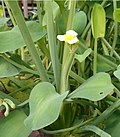 Limnocharis flava Habitus Flower

