Furaneol: Difference between revisions
CSV import |
CSV import |
||
| (2 intermediate revisions by the same user not shown) | |||
| Line 1: | Line 1: | ||
'''Furaneol''' is a naturally occurring organic compound that is | {{Short description|A chemical compound known for its sweet, strawberry-like aroma}} | ||
{{Chembox | |||
| Name = Furaneol | |||
| ImageFile = Furaneol.png | |||
| ImageSize = 200px | |||
| IUPACName = 4-Hydroxy-2,5-dimethyl-3(2H)-furanone | |||
| OtherNames = Strawberry furanone, 2,5-Dimethyl-4-hydroxy-3(2H)-furanone | |||
| ChemicalFormula = C<sub>6</sub>H<sub>8</sub>O<sub>3</sub> | |||
| MolarMass = 128.13 g/mol | |||
}} | |||
'''Furaneol''', also known as '''4-hydroxy-2,5-dimethyl-3(2H)-furanone''', is a naturally occurring organic compound that is widely recognized for its sweet, strawberry-like aroma. It is a key flavor compound in a variety of fruits and is used extensively in the food and fragrance industries. | |||
==Chemical Structure and Properties== | ==Chemical Structure and Properties== | ||
Furaneol | Furaneol is a furanone, a type of [[heterocyclic compound]] characterized by a five-membered ring containing an oxygen atom. Its chemical formula is C<sub>6</sub>H<sub>8</sub>O<sub>3</sub>, and it has a molar mass of 128.13 g/mol. The compound is notable for its pleasant, sweet aroma reminiscent of strawberries, which makes it a valuable additive in flavoring and perfumery. | ||
==Occurrence== | |||
Furaneol is found naturally in a variety of fruits, including [[strawberries]], [[pineapples]], and [[tomatoes]]. It is also present in [[caramel]] and [[coffee]], contributing to their characteristic flavors. The compound is produced during the [[Maillard reaction]], a chemical reaction between amino acids and reducing sugars that occurs during the cooking of foods. | |||
== | ==Synthesis== | ||
Furaneol | In addition to its natural occurrence, Furaneol can be synthesized in the laboratory. The synthetic production of Furaneol involves the reaction of [[acetone]] with [[glyoxylic acid]] in the presence of a catalyst. This process allows for the large-scale production of Furaneol for use in the food and fragrance industries. | ||
== | ==Applications== | ||
Furaneol is widely used as a flavoring agent in the food industry. Its sweet, fruity aroma makes it a popular choice for enhancing the flavor of [[confectionery]], [[baked goods]], and [[beverages]]. In the fragrance industry, Furaneol is used to impart a sweet, fruity note to perfumes and other scented products. | |||
==Safety | ==Health and Safety== | ||
Furaneol is generally recognized as safe (GRAS) by the [[Food and Drug Administration | Furaneol is generally recognized as safe (GRAS) by the [[Food and Drug Administration]] (FDA) when used in accordance with good manufacturing practices. However, as with all chemical compounds, it should be handled with care to avoid unnecessary exposure. | ||
== | ==Related Pages== | ||
* [[ | * [[Furan]] | ||
* [[Flavor | * [[Maillard reaction]] | ||
* [[ | * [[Flavor chemistry]] | ||
* [[Aroma compound]] | |||
[[Category:Flavor compounds]] | |||
[[Category:Food additives]] | |||
[[Category:Organic compounds]] | [[Category:Organic compounds]] | ||
<gallery caption="Furaneol"> | |||
File:(S)-Furanol_V1.svg|(S)-Furanol V1 | |||
File:(R)-Furanol_V1.svg|(R)-Furanol V1 | |||
</gallery> | |||
Latest revision as of 11:08, 25 February 2025
A chemical compound known for its sweet, strawberry-like aroma
| Chemical Compound | |
|---|---|
| Identifiers | |
| CAS Number | |
| PubChem CID | |
| ChemSpider ID | |
| UNII | |
| ChEBI | |
| ChEMBL | |
| Properties | |
| Chemical Formula | |
| Molar Mass | |
| Appearance | |
| Density | |
| Melting Point | |
| Boiling Point | |
| Hazards | |
| GHS Pictograms | [[File:|50px]] |
| GHS Signal Word | |
| GHS Hazard Statements | |
| NFPA 704 | [[File:|50px]] |
| References | |
Furaneol, also known as 4-hydroxy-2,5-dimethyl-3(2H)-furanone, is a naturally occurring organic compound that is widely recognized for its sweet, strawberry-like aroma. It is a key flavor compound in a variety of fruits and is used extensively in the food and fragrance industries.
Chemical Structure and Properties[edit]
Furaneol is a furanone, a type of heterocyclic compound characterized by a five-membered ring containing an oxygen atom. Its chemical formula is C6H8O3, and it has a molar mass of 128.13 g/mol. The compound is notable for its pleasant, sweet aroma reminiscent of strawberries, which makes it a valuable additive in flavoring and perfumery.
Occurrence[edit]
Furaneol is found naturally in a variety of fruits, including strawberries, pineapples, and tomatoes. It is also present in caramel and coffee, contributing to their characteristic flavors. The compound is produced during the Maillard reaction, a chemical reaction between amino acids and reducing sugars that occurs during the cooking of foods.
Synthesis[edit]
In addition to its natural occurrence, Furaneol can be synthesized in the laboratory. The synthetic production of Furaneol involves the reaction of acetone with glyoxylic acid in the presence of a catalyst. This process allows for the large-scale production of Furaneol for use in the food and fragrance industries.
Applications[edit]
Furaneol is widely used as a flavoring agent in the food industry. Its sweet, fruity aroma makes it a popular choice for enhancing the flavor of confectionery, baked goods, and beverages. In the fragrance industry, Furaneol is used to impart a sweet, fruity note to perfumes and other scented products.
Health and Safety[edit]
Furaneol is generally recognized as safe (GRAS) by the Food and Drug Administration (FDA) when used in accordance with good manufacturing practices. However, as with all chemical compounds, it should be handled with care to avoid unnecessary exposure.
Related Pages[edit]
- Furaneol
-
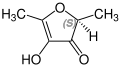 (S)-Furanol V1
 -
 (R)-Furanol V1
-Furanol_V1.svg)
-Furanol_V1.svg)
