Jamu: Difference between revisions
CSV import |
|||
| Line 52: | Line 52: | ||
File:Drinking_jamu_gendong_Bandar_Lampung.JPG|Drinking jamu gendong in Bandar Lampung | File:Drinking_jamu_gendong_Bandar_Lampung.JPG|Drinking jamu gendong in Bandar Lampung | ||
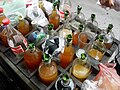
File:Jamu_stand_in_central_Java.jpg|Jamu stand in central Java | File:Jamu_stand_in_central_Java.jpg|Jamu stand in central Java | ||
</gallery> | </gallery> | ||
Latest revision as of 01:06, 25 February 2025
Traditional herbal medicine from Indonesia
Jamu is a traditional herbal medicine originating from Indonesia, which has been used for centuries to maintain health and treat various ailments. It is an integral part of Indonesian culture and is often prepared using natural ingredients such as roots, bark, flowers, seeds, leaves, and fruits. Jamu is typically consumed as a drink, but it can also be found in the form of powders, pills, and topical applications.
History[edit]
The practice of Jamu dates back to ancient times, with its roots in the Javanese royal courts. Historical records and traditional manuscripts, such as the Serat Centhini and Usada Bali, document the use of Jamu in Java and Bali. Over the centuries, Jamu has evolved, incorporating influences from Ayurveda, Traditional Chinese Medicine, and Islamic medicine.
Ingredients[edit]
Jamu is made from a wide variety of natural ingredients, each chosen for its specific health benefits. Common ingredients include:
- Turmeric (Curcuma longa) - Known for its anti-inflammatory properties.
- Ginger (Zingiber officinale) - Used to aid digestion and reduce nausea.
- Tamarind (Tamarindus indica) - Often used for its laxative effects.
- Galangal (Alpinia galanga) - Believed to improve circulation and digestion.
- Lemongrass (Cymbopogon citratus) - Used for its calming effects and to relieve pain.
Preparation[edit]
Jamu is traditionally prepared by grinding the ingredients into a paste, which is then mixed with water and boiled. The mixture is strained to remove solids, and the resulting liquid is consumed as a tonic. In modern times, Jamu is also produced commercially, with standardized recipes and packaging.
Health Benefits[edit]
Jamu is believed to offer a range of health benefits, including:
- Boosting the immune system
- Improving digestion
- Reducing inflammation
- Enhancing skin health
- Increasing energy levels
While many Indonesians swear by the efficacy of Jamu, scientific research on its health benefits is limited. However, some studies have shown that certain ingredients in Jamu, such as turmeric and ginger, do have medicinal properties.
Cultural Significance[edit]
Jamu is more than just a form of medicine; it is a cultural tradition passed down through generations. In Indonesia, Jamu is often sold by Mbok Jamu, traditional female herbalists who carry their wares in baskets or on bicycles. These women are a common sight in Indonesian cities and villages, offering their homemade remedies to locals.
Modern Developments[edit]
In recent years, Jamu has gained popularity outside of Indonesia, with an increasing number of people seeking natural and holistic health solutions. This has led to the establishment of Jamu cafes and wellness centers in various parts of the world.
Related pages[edit]
-
 Jamu
Jamu -
 Jamu Gendong
 -
 Bas-relief in Borobodur, Indonesia
 -
 Women preparing jamu at the market in Jogjakarta
 -
 Drinking jamu gendong in Bandar Lampung
 -
 Jamu stand in central Java


