Phagocyte: Difference between revisions
From WikiMD's Wellness Encyclopedia
CSV import |
CSV import |
||
| Line 37: | Line 37: | ||
{{stub}} | {{stub}} | ||
== Phagocyte == | |||
<gallery> | |||
File:Neutrophil_with_anthrax_copy.jpg|Neutrophil with anthrax | |||
File:Professeur_Metchnikoff,_portrait_du_scientifique_dans_un_laboratoire_de_recherche.jpg|Professeur Metchnikoff, portrait du scientifique dans un laboratoire de recherche | |||
File:Phagocytosis_in_three_steps.png|Phagocytosis in three steps | |||
File:Opsonin.png|Opsonin | |||
File:Phagocytosis2.png|Phagocytosis | |||
File:Gram-stain_of_gonorrhoea.jpg|Gram stain of gonorrhoea | |||
File:MHC_Class_I_processing.svg|MHC Class I processing | |||
File:Myeloid_cells.png|Myeloid cells | |||
File:NeutrophilerAktion.svg|Neutrophil action | |||
File:Monocytes,_a_type_of_white_blood_cell_(Giemsa_stained).jpg|Monocytes, a type of white blood cell (Giemsa stained) | |||
File:Gram_stain_of_a_macrophage_with_ingested_S_epidermidis_bacteria.jpg|Gram stain of a macrophage with ingested S. epidermidis bacteria | |||
File:Cutaneous_abscess_MRSA_staphylococcus_aureus_7826_lores.jpg|Cutaneous abscess MRSA staphylococcus aureus | |||
</gallery> | |||
Latest revision as of 21:45, 23 February 2025
Phagocyte
A phagocyte is a type of cell within the body capable of phagocytosis, a process that involves the engulfing and absorption of bacteria, other microorganisms, and foreign particles. Phagocytes form an important part of the immune system, which defends the body against infection.
Types of Phagocytes[edit]
There are several types of phagocytes in the body, including:
- Neutrophils: These are the most abundant type of phagocyte and are typically the first cells to arrive at the site of an infection.
- Monocytes: These cells are larger than neutrophils and have a longer lifespan. They can differentiate into macrophages and dendritic cells.
- Macrophages: These cells are named for their ability to move towards an infection site and engulf large particles.
- Dendritic Cells: These cells present antigens to T-cells, initiating an immune response.
Phagocytosis Process[edit]
The process of phagocytosis involves several steps:
- Chemotaxis: The phagocyte moves towards the source of infection or inflammation in response to chemical signals.
- Adherence: The phagocyte attaches to the microorganism or foreign particle.
- Ingestion: The phagocyte engulfs the microorganism or particle, forming a phagosome.
- Digestion: Lysosomes within the phagocyte fuse with the phagosome, releasing enzymes that break down the ingested material.
- Excretion: The indigestible waste is expelled from the phagocyte.
Role in Immune Response[edit]
Phagocytes play a crucial role in the body's immune response. They are responsible for the direct destruction of pathogens and also help to stimulate other immune cells to respond to the infection. In addition, phagocytes are involved in the removal of dead cells and other debris from the body, a process known as efferocytosis.
See Also[edit]
 | |
|---|---|
 |
 |
Phagocyte[edit]
-
 Neutrophil with anthrax
 -
 Professeur Metchnikoff, portrait du scientifique dans un laboratoire de recherche
 -
 Phagocytosis in three steps
 -
 Opsonin
 -
 Phagocytosis
 -
 Gram stain of gonorrhoea
 -
 MHC Class I processing
 -
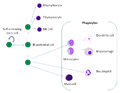 Myeloid cells
 -
 Neutrophil action
 -
 Monocytes, a type of white blood cell (Giemsa stained)
 -
 Gram stain of a macrophage with ingested S. epidermidis bacteria
 -
 Cutaneous abscess MRSA staphylococcus aureus


.jpg)


