Federation: Difference between revisions
CSV import Tags: mobile edit mobile web edit |
CSV import |
||
| Line 19: | Line 19: | ||
[[Category:Forms of government]] | [[Category:Forms of government]] | ||
{{medicine-stub}} | {{medicine-stub}} | ||
== Federation == | |||
<gallery> | |||
File:Map_of_unitary_and_federal_states.svg|Map of unitary and federal states | |||
File:The_pathway_of_regional_integration_or_separation.svg|The pathway of regional integration or separation | |||
File:Russian_Regions-EN.svg|Russian Regions | |||
File:Brazil,_administrative_divisions_(states)_-_en_-_colored.svg|Brazil, administrative divisions (states) | |||
File:Regions_of_Ethiopia_EN.svg|Regions of Ethiopia | |||
File:Nigeria_states.png|Nigeria states | |||
File:Mapa_Mexico_2010.PNG|Mapa Mexico 2010 | |||
File:Map_of_USA_with_state_names.svg|Map of USA with state names | |||
File:Political_map_of_Canada.svg|Political map of Canada | |||
File:Australia_states_and_territories_labelled.svg|Australia states and territories labelled | |||
File:Germany,_administrative_divisions_(+districts)_-_de_-_colored.svg|Germany, administrative divisions (+districts) | |||
File:Np.png|Np | |||
</gallery> | |||
Latest revision as of 21:40, 23 February 2025
Federation refers to a form of political organization characterized by a union of partially self-governing provinces, states, or other regions under a central (federal) government. In a federation, the self-governing status of the component states, as well as the division of power between them and the central government, is typically constitutionally entrenched and may not be altered by a unilateral decision of either party, state or federal authority.
Characteristics[edit]
The characteristics of federations can vary, but they generally include a constitution or charter that outlines the powers and functions of the federal government and the states. These powers are often divided into exclusive federal powers, exclusive state powers, and concurrent powers, which are shared by both levels of government. Federations often employ a bicameral legislature, with one chamber representing the population at large and the other representing the states or provinces.
Examples[edit]
Examples of federations include the United States, Germany, Australia, and Canada. Each of these countries has a distinct way of distributing powers between the central government and the constituent states or provinces.
Advantages and Disadvantages[edit]
Federations can offer several advantages, including allowing for diversity among the states or provinces, providing a balance of power that can prevent tyranny, and creating efficiencies in governance. However, federations can also face challenges, such as conflicts of jurisdiction between the central and state governments, disparities in economic development and public services across states, and complexities in administration and lawmaking.
Federal Systems Compared[edit]
The structure and operation of federations can be contrasted with two other forms of state organization: unitary states and confederations. In a unitary state, the central government holds the primary power, with any regional authorities exercising only the powers that the central government chooses to delegate. In contrast, a confederation is a union of sovereign states, united for purposes of common action often in relation to external affairs, but retaining their sovereignty and independence in internal matters.
Conclusion[edit]
Federations represent a middle ground between the tight central control of a unitary state and the loose alliance of a confederation. They offer a way to balance the need for a strong, unified presence on the international stage with the desire for regional autonomy and diversity.

Federation[edit]
-
 Map of unitary and federal states
 -
 The pathway of regional integration or separation
 -
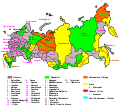 Russian Regions
 -
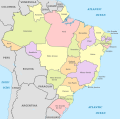 Brazil, administrative divisions (states)
 -
 Regions of Ethiopia
 -
 Nigeria states
 -
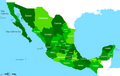 Mapa Mexico 2010
 -
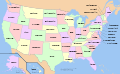 Map of USA with state names
 -
 Political map of Canada
 -
 Australia states and territories labelled
 -
 Germany, administrative divisions (+districts)
 -
 Np
Np


_-_en_-_colored.svg)


_-_de_-_colored.svg)

