Motility: Difference between revisions
CSV import |
CSV import |
||
| Line 29: | Line 29: | ||
{{stub}} | {{stub}} | ||
{{dictionary-stub1}} | {{dictionary-stub1}} | ||
<gallery> | |||
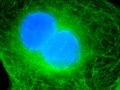
File:Binucleated_cell_overlay.tiff|Binucleated cell overlay | |||
File:Subcellular-and-supracellular-mechanical-stress-prescribes-cytoskeleton-behavior-in-Arabidopsis-elife01967v001.ogv|Subcellular and supracellular mechanical stress prescribes cytoskeleton behavior in Arabidopsis | |||
File:Muscular_system.svg|Muscular system | |||
File:Sperm-20051108.jpg|Sperm | |||
File:Cheetah_chase.jpg|Cheetah chase | |||
File:Phototropism.jpg|Phototropism | |||
File:FAGOCITOSI_BY_RAFF.gif|Phagocytosis by RAFF | |||
File:Protein_translation.gif|Protein translation | |||
</gallery> | |||
Latest revision as of 21:40, 23 February 2025
Motility refers to the ability of an organism or fluid to move spontaneously and actively, consuming energy in the process. It is not to be confused with mobility, which describes the ability of an object or organism to move, with or without assistance. Most animals are motile but the term applies to unicellular and simple multicellular organisms, as well as to some mechanisms of fluid flow in multicellular organisms and to some mechanisms of molecular biology.
Types of Motility[edit]
Motility may refer to:
- Cell migration, the movement of cells from one location to another, driven by protrusion of the cell membrane.
- Flagellar motility, a type of movement involving the whip-like appendages on cells.
- Ciliary motility, movement that uses hair-like structures to propel an organism or move fluid over a cell.
- Muscle contraction, the movement of a muscle in response to a signal from the nervous system.
- Cytoplasmic streaming, the directed flow of cytosol and organelles around large fungal and plant cells.
- Molecular motor, proteins that move along the surface of a suitable substrate. They are powered by the hydrolysis of ATP and convert chemical energy into mechanical work.
- Brownian motion, the random movement of particles in a fluid due to their collisions with other atoms or molecules.
- Gut motility, the stretching and contractions of the muscles in the gastrointestinal tract.
Clinical Significance[edit]
Motility issues can lead to a variety of health problems. For example, decreased gastrointestinal motility can lead to constipation, while increased motility can lead to diarrhea. In addition, motility issues can also affect other systems in the body, such as the nervous system, where decreased motility can lead to conditions like Parkinson's disease.