Sapphire: Difference between revisions
CSV import Tags: mobile edit mobile web edit |
CSV import |
||
| Line 24: | Line 24: | ||
{{stub}} | {{stub}} | ||
<gallery> | |||
File:Logan_Sapphire_SI.jpg|Logan Sapphire | |||
File:Saphir_gisements.jpg|Saphir gisements | |||
File:LgYellowSapphire.jpg|Large Yellow Sapphire | |||
File:Geschliffener_blauer_Saphir.jpg|Geschliffener blauer Saphir | |||
File:Sapphire_III_cropped_flash.jpg|Sapphire III | |||
File:Pink_sapphire_ring.jpg|Pink sapphire ring | |||
File:Padparadscha_sapphire.jpg|Padparadscha sapphire | |||
File:Star-Saphire.jpg|Star Sapphire | |||
File:+68_Komma_Sechs_-_Karat_Sternsafir_im_Rundmogulschliff_-_Herrenringfassung_-_750_Gelbgold_-_Russische_Goldschmiedemeister_-_Handarbeit_um_1990.jpg|68.6 Karat Sternsafir im Rundmogulschliff | |||
File:Corundum.png|Corundum | |||
File:Sapphire_ring.jpg|Sapphire ring | |||
File:1szafir_Madagaskar.jpg|Szafir Madagaskar | |||
</gallery> | |||
Latest revision as of 21:31, 23 February 2025
Sapphire is a precious gemstone, a variety of the mineral corundum, consisting of aluminium oxide (α-Al2O3) with trace amounts of elements such as iron, titanium, chromium, vanadium, or magnesium. It is typically blue, but natural "fancy" sapphires also occur in yellow, purple, orange, and green colors; "parti sapphires" show two or more colors. Red corundum stones also occur, but are called rubys not sapphires. Pink-colored corundum may be classified either as ruby or sapphire depending on locale.
History[edit]
The sapphire is one of the three gem-varieties of corundum, the other two being ruby (defined as corundum in a shade of red) and padparadscha (a pinkish orange variety). Although blue is their most well-known color, sapphires may also be colorless and they are found in many colors including shades of gray and black.
Geographical sources[edit]
Sapphires are found in India, Myanmar, Thailand, Vietnam, Sri Lanka, China, Australia, Brazil, Africa and North America (mainly in Montana). Madagascar, in the Indian Ocean, leads the world in sapphire production (as of 2007) though Sri Lanka continues to be the world leader in the production of high quality gemstones.
Synthetic sapphire[edit]
In 1902, the French chemist Auguste Verneuil developed a process for producing synthetic sapphire crystals. The process involves the fusion of alumina at very high temperatures. Verneuil patented the process in the United States in 1907.
Applications[edit]
Because of the remarkable hardness of sapphires – 9 on the Mohs scale (the third hardest mineral, after diamond at 10 and moissanite at 9.5) – sapphires are also used in some non-ornamental applications, including infrared optical components, such as in scientific instruments; high-durability windows; wristwatch crystals and movement bearings; and very thin electronic wafers, which are used as the insulating substrates of very special-purpose solid-state electronics (especially integrated circuits and GaN-based LEDs).
See also[edit]
 | |
|---|---|
 |
 |
-
 Logan Sapphire
 -
 Saphir gisements
 -
 Large Yellow Sapphire
 -
 Geschliffener blauer Saphir
 -
 Sapphire III
 -
 Pink sapphire ring
 -
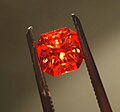 Padparadscha sapphire
 -
 Star Sapphire
 -
 68.6 Karat Sternsafir im Rundmogulschliff
 -
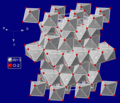 Corundum
 -
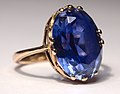 Sapphire ring
 -
 Szafir Madagaskar


