Memento mori: Difference between revisions
CSV import |
CSV import Tags: mobile edit mobile web edit |
||
| Line 34: | Line 34: | ||
{{stub}} | {{stub}} | ||
<gallery> | |||
File:Braque_Family_Triptych_closed_WGA.jpg|Braque Family Triptych Closed | |||
File:Edinburgh._St._Cuthbert's_Churchyard._Grave_of_James_Bailie._Detail.jpg|Grave of James Bailie Detail | |||
File:TombStJohnsChester.JPG|Tomb St John's Chester | |||
File:StillLifeWithASkull.jpg|Still Life With A Skull | |||
File:MANNapoli_109982_roue_de_la_fortune_memento_mori.jpg|Roue de la Fortune Memento Mori | |||
File:Le_Transi_de_René_de_Chalon_(Ligier_Richier).jpg|Le Transi de René de Chalon | |||
File:French_-_Pendant_with_a_Monk_and_Death_-_Walters_71461.jpg|Pendant with a Monk and Death | |||
File:Post-Medieval_ring_(FindID_468822)_(cropped).jpg|Post-Medieval Ring | |||
File:Young_Man_with_a_Skull,_Frans_Hals,_National_Gallery,_London.jpg|Young Man with a Skull | |||
File:Momento_mori_in_the_form_of_a_small_coffin,_probably_Southern_Germany,_1700s,_wax_figure_on_silk_in_a_wooden_coffin_-_Museum_Schnütgen_-_Cologne,_Germany_-_DSC09943.jpg|Momento Mori in the Form of a Small Coffin | |||
File:Brooch,_mourning_(AM_70980-3).jpg|Mourning Brooch | |||
File:Alarm_clock,_mounted_on_model_of_coffin.jpg|Alarm Clock Mounted on Model of Coffin | |||
</gallery> | |||
Latest revision as of 21:26, 23 February 2025
Memento Mori is a Latin phrase that translates to "remember that you will die." It serves as a symbolic reminder of the inevitability of death and the need to live life fully and mindfully. The concept has been widely used in art, literature, and cultural discourse throughout history.
History[edit]
The phrase "Memento Mori" originated in ancient Rome, where it was a common practice for a servant to whisper "Memento Mori" in the ear of a victorious general during a triumphal procession. This was done to remind the general of his mortality, despite his current success and glory Roman Triumph.
In the Middle Ages, the concept of Memento Mori became closely associated with the Christian practice of reflecting on mortality to lead a life free from sin. It was often depicted in art, literature, and architecture of the period Middle Ages.
In Art[edit]
Memento Mori has been a popular theme in art throughout history. It is often represented by symbols such as skulls, rotting fruit, and hourglasses, which serve as reminders of the inevitability of death. Famous works of art featuring Memento Mori include paintings by Hans Holbein the Younger and Pieter Claesz Hans Holbein the Younger, Pieter Claesz.
In Literature[edit]
The theme of Memento Mori is also prevalent in literature. It is often used to explore the human condition and the transient nature of life. Famous literary works featuring Memento Mori include "To the Virgins, to Make Much of Time" by Robert Herrick and "Elegy Written in a Country Churchyard" by Thomas Gray Robert Herrick, Thomas Gray.
In Modern Culture[edit]
In modern culture, Memento Mori is often used to promote mindfulness and the appreciation of life. It is a common theme in films, music, and popular literature. It also serves as a philosophical tool in Stoicism, a school of philosophy that teaches the development of self-control and fortitude as a means of overcoming destructive emotions Stoicism.
See Also[edit]
 | |
|---|---|
 |
 |
-
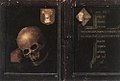 Braque Family Triptych Closed
 -
 Grave of James Bailie Detail
 -
 Tomb St John's Chester
 -
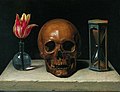 Still Life With A Skull
 -
 Roue de la Fortune Memento Mori
 -
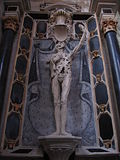 Le Transi de René de Chalon
 -
 Pendant with a Monk and Death
 -
 Post-Medieval Ring
 -
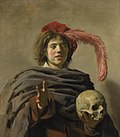 Young Man with a Skull
 -
 Momento Mori in the Form of a Small Coffin
 -
 Mourning Brooch
 -
 Alarm Clock Mounted on Model of Coffin


.jpg)

_(cropped).jpg)


.jpg)

