Electric field: Difference between revisions
CSV import |
CSV import |
||
| Line 32: | Line 32: | ||
{{stub}} | {{stub}} | ||
{{dictionary-stub1}} | {{dictionary-stub1}} | ||
<gallery> | |||
File:VFPt_image_charge_plane_horizontal.svg|VFPt image charge plane horizontal | |||
File:Cat_demonstrating_static_cling_with_styrofoam_peanuts.jpg|Cat demonstrating static cling with styrofoam peanuts | |||
File:VFPt_charges_plus_minus_thumb.svg|VFPt charges plus minus thumb | |||
File:VFPt_capacitor-square-plate.svg|VFPt capacitor square plate | |||
File:Electrostatic_induction.svg|Electrostatic induction | |||
File:Bremsstrahlung.gif|Bremsstrahlung | |||
File:Charged_infinite_wire_problem.svg|Charged infinite wire problem | |||
File:Charged_infinite_plane_problem.svg|Charged infinite plane problem | |||
File:Charged_infinite_cylinder_problem.svg|Charged infinite cylinder problem | |||
File:Charged_solid_sphere_problem.svg|Charged solid sphere problem | |||
File:Charged_spherical_surface_problem.svg|Charged spherical surface problem | |||
File:Charged_ring_problem.svg|Charged ring problem | |||
</gallery> | |||
Latest revision as of 21:23, 23 February 2025
Electric field is a concept in physics that describes the space around a charged particle where it can exert a force on other charged particles. The electric field is a vector field, meaning it has both a direction and a magnitude at every point in space. The direction of the electric field is the direction a positive test charge would move if placed in the field, and the magnitude of the electric field is the force experienced by a unit positive charge.
Definition[edit]
The electric field is defined as the force per unit charge exerted on a small positive test charge placed at that point. Mathematically, this is expressed as:
- E = F/q
where E is the electric field, F is the force experienced by the test charge, and q is the charge of the test charge.
Properties[edit]
Electric fields have several important properties:
- Superposition: The electric field due to a collection of charges is the vector sum of the fields due to each individual charge.
- Direction: The direction of the electric field at a point is the direction in which a positive test charge would move if placed at that point.
- Magnitude: The magnitude of the electric field at a point is the force experienced by a unit positive charge placed at that point.
Applications[edit]
Electric fields have many applications in physics and engineering, including:
- Electrostatics: The study of electric charges at rest and the electric fields they produce.
- Electrodynamics: The study of electric charges in motion and the electric and magnetic fields they produce.
- Electrical engineering: The design and analysis of electrical and electronic systems.
See also[edit]
 | |
|---|---|
 |
 |
-
 VFPt image charge plane horizontal
 -
 Cat demonstrating static cling with styrofoam peanuts
 -
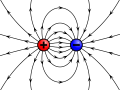 VFPt charges plus minus thumb
 -
 VFPt capacitor square plate
 -
 Electrostatic induction
 -
 Bremsstrahlung
 -
 Charged infinite wire problem
 -
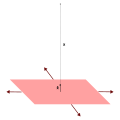 Charged infinite plane problem
 -
 Charged infinite cylinder problem
 -
 Charged solid sphere problem
 -
 Charged spherical surface problem
 -
 Charged ring problem


