Septum transversum: Difference between revisions
CSV import Tags: mobile edit mobile web edit |
CSV import Tags: mobile edit mobile web edit |
||
| Line 30: | Line 30: | ||
{{Medicine-stub}} | {{Medicine-stub}} | ||
<gallery> | |||
File:Diaphragma-embryo.png|Diaphragma embryo | |||
File:Gray1088.png|Gray's Anatomy Plate 1088 | |||
File:Gray984.png|Gray's Anatomy Plate 984 | |||
</gallery> | |||
Latest revision as of 21:21, 23 February 2025
Septum Transversum
The Septum Transversum is a thick mass of cranial mesenchymal tissue that plays a crucial role in the embryonic development of the thoracic and abdominal cavities. It forms a significant part of the diaphragm, the muscular sheet separating these two cavities. The development and function of the Septum Transversum are essential for understanding various congenital conditions related to the diaphragm and the organs it interacts with.
Development[edit]
The Septum Transversum originates early in the embryonic period, around the third week of gestation. It initially appears as a thick, crescent-shaped mass of tissue lying beneath the developing heart. As the embryo grows, the Septum Transversum descends to a position just above the liver, contributing to the formation of the central tendon of the diaphragm. This process is influenced by various genetic and molecular signals, including the action of homeobox (HOX) genes and the retinoic acid pathway.
During its descent, the Septum Transversum interacts with other developing structures, such as the pleuroperitoneal folds, dorsal mesentery, and esophageal mesentery. These interactions are crucial for the proper closure of the diaphragm and the separation of the thoracic and abdominal cavities.
Function[edit]
The primary function of the Septum Transversum is to contribute to the formation of the diaphragm. The diaphragm is essential for respiration, as it contracts and relaxes to allow the lungs to fill and empty of air. Additionally, the diaphragm maintains the pressure differences between the thoracic and abdominal cavities, which is crucial for the proper functioning of the abdominal organs.
Clinical Significance[edit]
Abnormal development of the Septum Transversum can lead to congenital diaphragmatic hernia (CDH), a condition where abdominal organs herniate into the thoracic cavity through defects in the diaphragm. This can severely affect lung development and function, requiring surgical intervention after birth. Understanding the embryological development of the Septum Transversum is crucial for diagnosing and managing CDH and other related conditions.
Related Structures[edit]
See Also[edit]

-
 Diaphragma embryo
 -
 Gray's Anatomy Plate 1088
 -
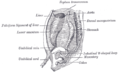 Gray's Anatomy Plate 984


