Dutch East Indies: Difference between revisions
CSV import Tags: mobile edit mobile web edit |
CSV import |
||
| Line 35: | Line 35: | ||
[[Category:Dutch colonial empire]] | [[Category:Dutch colonial empire]] | ||
{{dictionary-stub1}} | {{dictionary-stub1}} | ||
<gallery> | |||
File:1916_Dutch_East_Indies_-_Art.jpg|1916 Dutch East Indies - Art | |||
File:Royal_barge_or_prau_pengluput_with_dragon_head,_Bengawan_Solo_river_(near_gresik).jpg|Royal barge or prau pengluput with dragon head, Bengawan Solo river (near gresik) | |||
File:Dutch_East_Indies_Expansion.gif|Dutch East Indies Expansion | |||
File:Benda_sejarah_diduga_senjata_Belanda.jpg|Benda sejarah diduga senjata Belanda | |||
File:Prince_Diponegoro_of_Java.jpg|Prince Diponegoro of Java | |||
File:COLLECTIE_TROPENMUSEUM_Man_poseert_tussen_megalieten_bij_Batoeberak_TMnr_10025819.jpg|Man poseert tussen megalieten bij Batoeberak | |||
File:Nicolaas_Pieneman_-_The_Submission_of_Prince_Dipo_Negoro_to_General_De_Kock.jpg|The Submission of Prince Dipo Negoro to General De Kock | |||
File:COLLECTIE_TROPENMUSEUM_Olieverfschilderij_voorstellende_het_Kasteel_Batavia_gezien_van_Kali_Besar_west_met_op_de_voorgrond_de_vismarkt_TMnr_118-167.jpg|Olieverfschilderij voorstellende het Kasteel Batavia gezien van Kali Besar west met op de voorgrond de vismarkt | |||
File:COLLECTIE_TROPENMUSEUM_De_nieuwe_Gouverneur-Generaal_Tjarda_van_Starkenborgh_Stachouwer_verlaat_samen_met_de_zojuist_afgetreden_G.G._B.C._de_Jonge_het_gebouw_van_de_Volksraad_waar_de_bestuursoverdracht_plaatsvond_TMnr_10018818.jpg|De nieuwe Gouverneur-Generaal Tjarda van Starkenborgh Stachouwer verlaat samen met de zojuist afgetreden G.G. B.C. de Jonge het gebouw van de Volksraad waar de bestuursoverdracht plaatsvond | |||
File:Bezoek_van_generaal_Tojo_aan_Java.webm|Bezoek van generaal Tojo aan Java | |||
</gallery> | |||
Latest revision as of 21:11, 23 February 2025
Dutch East Indies was a Dutch colony that became modern Indonesia following World War II. It was formed from the nationalised colonies of the Dutch East India Company, which came under the administration of the Dutch government in 1800.
History[edit]
The Dutch East India Company (VOC) had been formed in the early 17th century and the company had established its first permanent trading post in the area that is now Indonesia by 1603. The VOC was granted a monopoly on trade in the region by the Dutch government and by the mid-17th century, it had become the dominant power in the region.
In the early 19th century, the Dutch government nationalised the VOC and established the Dutch East Indies as a national colony. The colony was initially administered by a Governor-General, but this position was later replaced by a council of colonial officials.
The Dutch East Indies was one of the most valuable European colonies in the world due to its rich natural resources, including rubber, oil, and spices. The colony was also a major source of revenue for the Dutch government.
Economy[edit]
The economy of the Dutch East Indies was heavily dependent on agriculture, particularly the cultivation of rice, coffee, tea, tobacco, rubber, and spices. The colony was also a major producer of oil and was one of the world's leading exporters of rubber.
The Dutch government implemented a system of forced labour, known as the Cultivation System, which required Indonesian farmers to devote a portion of their land to growing cash crops for export. This system was highly profitable for the Dutch government, but it led to widespread poverty and famine among the Indonesian population.
Independence[edit]
The Dutch East Indies declared independence as the Republic of Indonesia in 1945, following the end of World War II. The Dutch government initially attempted to reassert control over the colony, but it was forced to recognise Indonesian independence in 1949 following international pressure.
See also[edit]
References[edit]
<references />
 | |
|---|---|
 |
 |
-
 1916 Dutch East Indies - Art
 -
 Royal barge or prau pengluput with dragon head, Bengawan Solo river (near gresik)
 -
 Dutch East Indies Expansion
 -
 Benda sejarah diduga senjata Belanda
 -
 Prince Diponegoro of Java
 -
 Man poseert tussen megalieten bij Batoeberak
 -
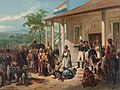 The Submission of Prince Dipo Negoro to General De Kock
 -
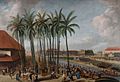 Olieverfschilderij voorstellende het Kasteel Batavia gezien van Kali Besar west met op de voorgrond de vismarkt
 -
 De nieuwe Gouverneur-Generaal Tjarda van Starkenborgh Stachouwer verlaat samen met de zojuist afgetreden G.G. B.C. de Jonge het gebouw van de Volksraad waar de bestuursoverdracht plaatsvond
 -
 Bezoek van generaal Tojo aan Java

.jpg)


