Biological hazard: Difference between revisions
CSV import |
CSV import Tags: mobile edit mobile web edit |
||
| Line 32: | Line 32: | ||
{{safety-stub}} | {{safety-stub}} | ||
{{health-stub}} | {{health-stub}} | ||
<gallery> | |||
File:Biohazard_symbol.svg|Biohazard symbol | |||
File:Sharps_Container.jpg|Sharps container | |||
File:Army_trainers_teach_NHS_medics_how_to_put_on_Ebola_safety_suits_(15650293350).jpg|Army trainers teach NHS medics how to put on Ebola safety suits | |||
</gallery> | |||
Latest revision as of 21:00, 23 February 2025
Biological Hazard
A biological hazard, or biohazard, is a biological substance that poses a threat to the health of living organisms, primarily humans. This can include medical waste, samples of a microorganism, virus or toxin that can impact human health. It can also include substances harmful to other animals.
Types of Biological Hazards[edit]
There are several types of biological hazards. These include:
- Bacteria: These are single-celled organisms that can cause diseases such as tuberculosis, salmonella, and anthrax.
- Viruses: These are smaller than bacteria and can cause diseases such as influenza, HIV/AIDS, and COVID-19.
- Fungi: These organisms can cause diseases such as ringworm, athlete's foot, and histoplasmosis.
- Parasites: These organisms live on or in a host organism and can cause diseases such as malaria, giardiasis, and toxoplasmosis.
Risk Levels[edit]
Biological hazards are classified into four levels, from Level 1 (lowest risk) to Level 4 (highest risk). The Centers for Disease Control and Prevention (CDC) and the World Health Organization (WHO) provide guidelines for the handling and transportation of these hazards.
Prevention and Control[edit]
Prevention and control of biological hazards can be achieved through a combination of tactics. These include personal protective equipment (PPE), good personal hygiene, use of vaccines, and proper handling and disposal of waste.
See Also[edit]

This safety related article is a stub. You can help WikiMD by expanding it.

-
 Biohazard symbol
 -
 Sharps container
 -
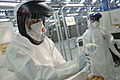 Army trainers teach NHS medics how to put on Ebola safety suits


.jpg)
