Solanum dulcamara: Difference between revisions
CSV import Tags: mobile edit mobile web edit |
No edit summary |
||
| (3 intermediate revisions by the same user not shown) | |||
| Line 1: | Line 1: | ||
'''Solanum dulcamara''', | [[File:Solanum_dulcamara_(5386574212).jpg|thumb|right|Solanum dulcamara in bloom]] | ||
'''Solanum dulcamara''', commonly known as bittersweet, bittersweet nightshade, or woody nightshade, is a species of vine in the family [[Solanaceae]]. It is native to [[Europe]] and [[Asia]], but has spread to other parts of the world, including [[North America]]. | |||
== Description == | == Description == | ||
== Distribution | [[File:Illustration_Solanum_dulcamara0.jpg|thumb|left|Botanical illustration of Solanum dulcamara]] | ||
Solanum dulcamara is a semi-woody perennial vine that can grow up to 4 meters in length. The leaves are ovate to heart-shaped, often with three lobes, and are arranged alternately on the stem. The plant produces clusters of small, star-shaped flowers that are typically purple with yellow stamens. The fruit is a bright red berry, which is toxic to humans and animals if ingested. | |||
== Habitat and Distribution == | |||
[[File:Solanum-dulcamara-Distribution-PhytoKeys-022-001-g036.jpg|thumb|right|Distribution map of Solanum dulcamara]] | |||
Solanum dulcamara thrives in a variety of habitats, including wetlands, riverbanks, and disturbed areas. It prefers moist, well-drained soils and can often be found climbing over shrubs and trees. The plant is widely distributed across Europe and Asia and has been introduced to North America, where it is considered an invasive species in some regions. | |||
== Toxicity == | |||
The berries of Solanum dulcamara contain solanine, a toxic alkaloid that can cause symptoms such as nausea, vomiting, and diarrhea if ingested. The leaves and stems also contain toxic compounds, making the entire plant potentially harmful to humans and animals. | |||
== Uses == | == Uses == | ||
== | Despite its toxicity, Solanum dulcamara has been used in traditional medicine for its purported anti-inflammatory and diuretic properties. However, due to the risk of poisoning, its use is not recommended without professional guidance. | ||
== Cultivation == | |||
[[File:SolanumDulcamara-bloem-sm.jpg|thumb|left|Close-up of Solanum dulcamara flowers]] | |||
Solanum dulcamara is sometimes cultivated as an ornamental plant for its attractive flowers and berries. It can be propagated by seed or cuttings and requires a support structure to climb. The plant prefers full sun to partial shade and moist soil conditions. | |||
== Related Species == | |||
Solanum dulcamara is closely related to other members of the [[Solanum]] genus, including the [[potato]] (''Solanum tuberosum'') and the [[tomato]] (''Solanum lycopersicum''). | |||
== Related Pages == | |||
* [[Solanaceae]] | |||
* [[Solanum]] | |||
* [[Invasive species]] | |||
== Gallery == | |||
<gallery> | |||
File:XN_Solanum_dulcamara_01.jpg|Solanum dulcamara foliage | |||
File:Solanum_dulcamara,_Fogner,_Oslo..JPG|Solanum dulcamara in Oslo | |||
File:Bittersweet_Nightshade.JPG|Bittersweet nightshade plant | |||
</gallery> | |||
[[Category:Solanaceae]] | |||
[[Category:Flora of Europe]] | [[Category:Flora of Europe]] | ||
[[Category:Flora of Asia]] | [[Category:Flora of Asia]] | ||
[[Category:Invasive plant species in | [[Category:Invasive plant species in North America]] | ||
Latest revision as of 14:31, 22 February 2025
.jpg)
Solanum dulcamara, commonly known as bittersweet, bittersweet nightshade, or woody nightshade, is a species of vine in the family Solanaceae. It is native to Europe and Asia, but has spread to other parts of the world, including North America.
Description[edit]

Solanum dulcamara is a semi-woody perennial vine that can grow up to 4 meters in length. The leaves are ovate to heart-shaped, often with three lobes, and are arranged alternately on the stem. The plant produces clusters of small, star-shaped flowers that are typically purple with yellow stamens. The fruit is a bright red berry, which is toxic to humans and animals if ingested.
Habitat and Distribution[edit]

Solanum dulcamara thrives in a variety of habitats, including wetlands, riverbanks, and disturbed areas. It prefers moist, well-drained soils and can often be found climbing over shrubs and trees. The plant is widely distributed across Europe and Asia and has been introduced to North America, where it is considered an invasive species in some regions.
Toxicity[edit]
The berries of Solanum dulcamara contain solanine, a toxic alkaloid that can cause symptoms such as nausea, vomiting, and diarrhea if ingested. The leaves and stems also contain toxic compounds, making the entire plant potentially harmful to humans and animals.
Uses[edit]
Despite its toxicity, Solanum dulcamara has been used in traditional medicine for its purported anti-inflammatory and diuretic properties. However, due to the risk of poisoning, its use is not recommended without professional guidance.
Cultivation[edit]

Solanum dulcamara is sometimes cultivated as an ornamental plant for its attractive flowers and berries. It can be propagated by seed or cuttings and requires a support structure to climb. The plant prefers full sun to partial shade and moist soil conditions.
Related Species[edit]
Solanum dulcamara is closely related to other members of the Solanum genus, including the potato (Solanum tuberosum) and the tomato (Solanum lycopersicum).
Related Pages[edit]
Gallery[edit]
-
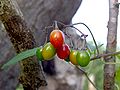 Solanum dulcamara foliage
 -
 Solanum dulcamara in Oslo
 -
 Bittersweet nightshade plant


