Carob: Difference between revisions
CSV import |
CSV import |
||
| (2 intermediate revisions by the same user not shown) | |||
| Line 1: | Line 1: | ||
''' | {{short description|Evergreen tree in the pea family, cultivated for its edible pods}} | ||
{{Use dmy dates|date=October 2023}} | |||
[[File:Ceratonia_siliqua_Keciboynuzu_1370984_Nevit.jpg|thumb|right|Carob tree with pods]] | |||
The '''carob''' (''Ceratonia siliqua'') is an evergreen tree in the family [[Fabaceae]], native to the Mediterranean region. It is cultivated for its edible pods, which are used as a substitute for [[chocolate]]. | |||
==Description== | ==Description== | ||
The carob tree can grow up to 15 meters | [[File:Carob_tree_leaf.JPG|thumb|left|Carob tree leaves]] | ||
The carob tree is a flowering evergreen shrub or tree that can grow up to 15 meters in height. It has a broad crown and thick trunk. The leaves are pinnate, with 6 to 10 leaflets, and are glossy and dark green. | |||
==Cultivation== | ==Cultivation== | ||
Carob trees are | Carob trees are well-suited to the Mediterranean climate, thriving in hot, dry regions. They are drought-tolerant and can grow in poor soils. The trees are typically propagated by seed or grafting. | ||
==Uses== | ==Uses== | ||
[[File:Illustration Ceratonia siliqua0.jpg|thumb|right|Botanical illustration of carob]] | |||
The carob pods, also known as locust beans, are harvested and processed to produce carob powder, which is used as a [[cocoa]] substitute. Carob is naturally sweet and contains no [[caffeine]]. | |||
===Culinary=== | |||
Carob powder is used in baking and confectionery. It is often used to make carob chips, which are a chocolate alternative in cookies and other baked goods. | |||
[[File:Carob chocolate chip cookies with coconut and cranberries.jpg|thumb|left|Carob chocolate chip cookies]] | |||
===Confections=== | |||
Carob is used to make various confections, including carob bars and candies. It is also used in beverages, such as carob liqueur. | |||
[[File:Carob Confections.png|thumb|right|Carob confections]] | |||
Carob | |||
== | ===Other Uses=== | ||
The | Carob pods are also used as animal feed. The seeds are used to produce locust bean gum, a thickening agent in the food industry. | ||
== | ==Cultural Significance== | ||
Carob has been cultivated for thousands of years and has historical significance in the Mediterranean region. It is sometimes referred to as "St. John's bread" due to the belief that [[John the Baptist]] subsisted on carob pods in the wilderness. | |||
== | ==Gallery== | ||
Carob | <gallery> | ||
File:Arcosu07.jpg|Carob tree in its natural habitat | |||
File:Garroves.JPG|Carob pods on the tree | |||
File:A bottle of Maltese carob liqueur with the north coast of Gozo Island in the background (Malta, April 2009).jpg|Maltese carob liqueur | |||
</gallery> | |||
==Related pages== | |||
[[ | * [[Chocolate]] | ||
[[ | * [[Fabaceae]] | ||
[[ | * [[Mediterranean cuisine]] | ||
[[Category:Fabaceae]] | |||
[[Category:Edible legumes]] | |||
[[Category:Flora of the Mediterranean Basin]] | |||
Latest revision as of 14:11, 21 February 2025
Evergreen tree in the pea family, cultivated for its edible pods

The carob (Ceratonia siliqua) is an evergreen tree in the family Fabaceae, native to the Mediterranean region. It is cultivated for its edible pods, which are used as a substitute for chocolate.
Description[edit]

The carob tree is a flowering evergreen shrub or tree that can grow up to 15 meters in height. It has a broad crown and thick trunk. The leaves are pinnate, with 6 to 10 leaflets, and are glossy and dark green.
Cultivation[edit]
Carob trees are well-suited to the Mediterranean climate, thriving in hot, dry regions. They are drought-tolerant and can grow in poor soils. The trees are typically propagated by seed or grafting.
Uses[edit]

The carob pods, also known as locust beans, are harvested and processed to produce carob powder, which is used as a cocoa substitute. Carob is naturally sweet and contains no caffeine.
Culinary[edit]
Carob powder is used in baking and confectionery. It is often used to make carob chips, which are a chocolate alternative in cookies and other baked goods.

Confections[edit]
Carob is used to make various confections, including carob bars and candies. It is also used in beverages, such as carob liqueur.

Other Uses[edit]
Carob pods are also used as animal feed. The seeds are used to produce locust bean gum, a thickening agent in the food industry.
Cultural Significance[edit]
Carob has been cultivated for thousands of years and has historical significance in the Mediterranean region. It is sometimes referred to as "St. John's bread" due to the belief that John the Baptist subsisted on carob pods in the wilderness.
Gallery[edit]
-
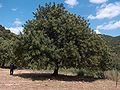 Carob tree in its natural habitat
 -
 Carob pods on the tree
 -
 Maltese carob liqueur


.jpg)
