Blue cheese: Difference between revisions
CSV import |
CSV import |
||
| Line 27: | Line 27: | ||
[[Category:Mold]] | [[Category:Mold]] | ||
{{cheese-stub}} | {{cheese-stub}} | ||
<gallery> | |||
File:Bleu_au_lait_de_chèvre.jpg|Bleu au lait de chèvre | |||
File:Bleu_de_Gex.jpg|Bleu de Gex | |||
File:Bavaria_blu_01_WikiCheese_Lokal_K.jpg|Bavaria blu | |||
File:2015-01-25_Jersey_Blue_-_Städtchäsi_Lichtensteig_-_der_Schweizer_-_hu_-_8005.jpg|Jersey Blue | |||
File:Blue_cheese_plates.jpg|Blue cheese plates | |||
File:GorgonzolaDSC4233.jpg|Gorgonzola | |||
File:Homemade_Stilton_Blue_Cheese_in_UK.jpg|Homemade Stilton Blue Cheese | |||
File:Wikicheese_-_Roquefort_-_20150417_-_003.jpg|Roquefort | |||
File:A_Plate_of_Blue_Cheese_at_Lighthouse_Cafe.jpg|A Plate of Blue Cheese at Lighthouse Cafe | |||
File:A_Blue_Cheese_from_Holiday_Inn_Goldmile.jpg|A Blue Cheese from Holiday Inn Goldmile | |||
File:A_Danish_Blue_Cheese_with_Fig_from_The_Astor.jpg|A Danish Blue Cheese with Fig from The Astor | |||
File:Blue_Stilton_01.jpg|Blue Stilton | |||
File:Stichleton.jpg|Stichleton | |||
</gallery> | |||
Latest revision as of 21:26, 20 February 2025
Blue cheese is a general term used to classify cheeses that have been cultured with the mold Penicillium, resulting in spots or veins of blue, blue-gray or blue-green mold throughout the cheese. The distinct flavor and aroma of blue cheese are recognized as being sharp, salty, and strong.
History[edit]
The discovery of blue cheese is believed to have been an accident. The cheeses were stored in natural temperatures and moisture-controlled caves, which happen to be favorable environments for many varieties of harmless mold. After the discovery of Penicillium roqueforti, the mold used to make blue cheese, the process of making blue cheese was refined and perfected.
Production[edit]
Blue cheese is made from cow's, sheep's, or goat's milk. During the cheese-making process, Penicillium cultures are added. The cheese is then aged in a temperature-controlled environment such as a cave. Blue cheese can be eaten by itself or can be spread, crumbled or melted into or over a range of different recipes.
Varieties[edit]
There are many varieties of blue cheese, some of the most well-known include:
- Roquefort: A French blue cheese made from sheep's milk.
- Gorgonzola: An Italian blue cheese made from cow's milk.
- Stilton: An English blue cheese made from cow's milk.
- Danish Blue: A Danish blue cheese made from cow's milk.
Health Benefits[edit]
Blue cheese is rich in protein, calcium, and vitamin B12. However, it is also high in sodium and cholesterol, which should be considered for those with dietary restrictions.
See Also[edit]

-
 Bleu au lait de chèvre
 -
 Bleu de Gex
 -
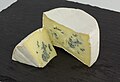 Bavaria blu
 -
 Jersey Blue
 -
 Blue cheese plates
 -
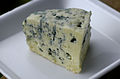 Gorgonzola
 -
 Homemade Stilton Blue Cheese
 -
 Roquefort
 -
 A Plate of Blue Cheese at Lighthouse Cafe
 -
 A Blue Cheese from Holiday Inn Goldmile
 -
 A Danish Blue Cheese with Fig from The Astor
 -
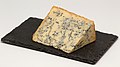 Blue Stilton
 -
 Stichleton


