Crop yield: Difference between revisions
CSV import |
CSV import |
||
| Line 36: | Line 36: | ||
{{Agriculture-stub}} | {{Agriculture-stub}} | ||
<gallery> | |||
File:Cereal-crop-yield-vs-fertilizer-application_(OWID_0112).png|Cereal crop yield vs fertilizer application | |||
</gallery> | |||
Latest revision as of 21:25, 20 February 2025
Crop yield refers to the measure of agricultural output, specifically the amount of a crop produced per unit of land area. It is a critical indicator of agricultural productivity and efficiency, playing a vital role in food security, economic planning, and sustainable agriculture. Crop yield is influenced by a variety of factors including genetics, soil quality, water availability, climate, pests and diseases, and the application of technologies and farming practices.
Factors Affecting Crop Yield[edit]
Several key factors impact the yield of crops, each interplaying in complex ways:
Genetics[edit]
The genetic makeup of a crop variety determines its potential for growth and resistance to adverse conditions. Plant breeding and genetic engineering have been instrumental in developing high-yield varieties.
Soil Quality[edit]
Soil health is fundamental for crop growth. Nutrient availability, pH levels, soil structure, and organic matter content are crucial for optimal plant development.
Water Availability[edit]
Irrigation is essential in regions with insufficient rainfall. The efficiency of water use, through practices like drip irrigation, significantly affects crop yield.
Climate[edit]
Temperature and sunlight are critical for photosynthesis, while extreme weather events like droughts and floods can devastate crops.
Pests and Diseases[edit]
Managing pests and diseases through integrated pest management practices is vital to protect crops and ensure high yields.
Agricultural Practices[edit]
Farming techniques, including crop rotation, tillage practices, and the timing of planting and harvesting, influence yield outcomes.
Measuring Crop Yield[edit]
Crop yield is typically measured in terms of weight per unit area, such as kilograms per hectare or bushels per acre. Yield estimation involves assessing the amount of crop harvested in relation to the size of the land cultivated.
Improving Crop Yield[edit]
Advancements in agricultural science and technology offer numerous strategies for enhancing crop yields. These include precision agriculture, improved irrigation techniques, genetically modified crops, and sustainable farming practices that conserve resources while maximizing output.
Challenges and Future Directions[edit]
Sustaining and increasing crop yields faces challenges from climate change, soil degradation, and the need to produce more food for a growing global population while minimizing environmental impacts. Research and innovation in agriculture continue to focus on developing resilient crop varieties, improving resource use efficiency, and adopting sustainable farming practices.

This article is a agriculture stub. You can help WikiMD by expanding it!
-
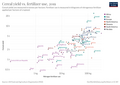 Cereal crop yield vs fertilizer application
.png)
