Hefutoxin: Difference between revisions
CSV import |
CSV import |
||
| Line 35: | Line 35: | ||
[[Category:Ion channel toxins]] | [[Category:Ion channel toxins]] | ||
[[Category:Tarantula venom]] | [[Category:Tarantula venom]] | ||
<gallery> | |||
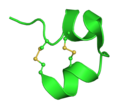
File:1hp9.png|Hefutoxin | |||
</gallery> | |||
Latest revision as of 21:15, 20 February 2025
Hefutoxin is a type of neurotoxin found in the venom of certain species of tarantulas. It is a small peptide toxin that affects ion channels in the nervous system, particularly targeting potassium channels.
Structure[edit]
Hefutoxin is a peptide composed of a specific sequence of amino acids. The structure of hefutoxin is stabilized by disulfide bonds, which are common in many venom-derived peptides. These bonds help maintain the three-dimensional conformation necessary for its biological activity.
Mechanism of Action[edit]
Hefutoxin exerts its effects by binding to and inhibiting the function of voltage-gated potassium channels. These channels are crucial for the repolarization phase of the action potential in neurons. By blocking these channels, hefutoxin prolongs the action potential, leading to increased neuronal excitability. This can result in a range of physiological effects, depending on the organism and the specific channels targeted.
Biological Effects[edit]
In its natural context, hefutoxin likely plays a role in the tarantula's ability to subdue prey or deter predators. In experimental settings, it has been used to study the function of potassium channels and the role they play in neuronal signaling.
Applications in Research[edit]
Hefutoxin is valuable in neurophysiological research as a tool for probing the function of potassium channels. By selectively inhibiting these channels, researchers can better understand their role in various physiological processes and their potential as targets for therapeutic intervention.
Also see[edit]
-
 Hefutoxin

