Blind insertion airway device: Difference between revisions
CSV import Tags: mobile edit mobile web edit |
CSV import |
||
| Line 50: | Line 50: | ||
{{Medical equipment-stub}} | {{Medical equipment-stub}} | ||
<gallery> | |||
File:One-piece Guedel Airways.jpg|Blind insertion airway device | |||
File:Combitube.JPG|Blind insertion airway device | |||
File:Laryngeal Tube.JPG|Blind insertion airway device | |||
File:Laryngeal mask 100.jpg|Blind insertion airway device | |||
File:Oral Airway (4) Adult Large.JPG|Blind insertion airway device | |||
File:Wendltubus.jpg|Blind insertion airway device | |||
</gallery> | |||
Latest revision as of 01:35, 20 February 2025
Blind Insertion Airway Device
A blind insertion airway device (BIAD) is a type of airway management tool used in medical emergencies and anesthesia to maintain or open a patient's airway. Unlike other airway devices that require visualization of the vocal cords for placement, BIADs are designed for insertion without the need for direct sight of the airway, making them invaluable in situations where intubation is difficult or impossible.
Types of Blind Insertion Airway Devices[edit]
There are several types of BIADs, each with unique features and specific use cases. The most commonly used devices include:
- Laryngeal Mask Airway (LMA): A supraglottic airway device that is placed over the laryngeal inlet to allow ventilation.
- Esophageal Tracheal Combitube: A dual-lumen airway device that can be inserted into either the esophagus or trachea, allowing for ventilation in both routine and emergency situations.
- I-gel: A supraglottic airway device made of a thermoplastic elastomer, which is designed to create a non-inflatable, anatomical seal of the pharyngeal, laryngeal, and perilaryngeal structures.
- King LT: A disposable, latex-free supraglottic airway device that is designed to provide a patent airway when conventional endotracheal intubation is not feasible.
Indications[edit]
BIADs are indicated in various scenarios, including:
- Emergency airway management when intubation is not possible
- Elective anesthesia for surgeries where intubation is not necessary
- As a backup airway device in difficult airway situations
Contraindications[edit]
While BIADs are versatile, there are contraindications to their use, such as:
- Patients with a high risk of aspiration
- Severe airway obstruction that cannot accommodate the device
- Inability to ventilate or oxygenate adequately with the device
Insertion Technique[edit]
The insertion technique varies slightly among the different types of BIADs but generally follows these steps:
1. Prepare the patient and the device according to the manufacturer's instructions. 2. Position the patient appropriately, usually with the neck in a neutral or slightly extended position. 3. Lubricate the device, if necessary. 4. Insert the device blindly into the patient's mouth, following the natural curvature of the airway. 5. Once inserted, confirm proper placement by assessing for adequate ventilation and absence of gastric insufflation.
Complications[edit]
Complications from BIAD use are rare but can include:
- Inadequate ventilation
- Aspiration
- Airway trauma
- Incorrect placement
Conclusion[edit]
Blind insertion airway devices are a critical component of airway management in both emergency and elective settings. Their ability to secure an airway without the need for direct visualization of the vocal cords makes them invaluable in difficult airway scenarios. However, proper training and familiarity with the devices are essential to minimize complications and ensure patient safety.
This article is a Medical equipment-related stub. You can help WikiMD by expanding it!
-
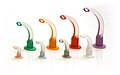 Blind insertion airway device
 -
 Blind insertion airway device
 -
 Blind insertion airway device
 -
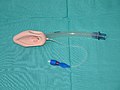 Blind insertion airway device
 -
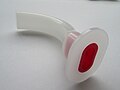 Blind insertion airway device
 -
 Blind insertion airway device


_Adult_Large.JPG)

