Sangak: Difference between revisions
CSV import |
CSV import |
||
| Line 33: | Line 33: | ||
* [Example Website] | * [Example Website] | ||
{{dictionary-stub1}} | {{dictionary-stub1}} | ||
== Sangak == | |||
<gallery> | |||
File:Sangak 17.jpg|Sangak | |||
File:Sangak 05.jpg|Sangak | |||
File:BREAD • Baked Fresh Daily • Isfahan • IRAN.webm|Sangak | |||
File:Sangak bakery in tehran.jpg|Sangak | |||
File:Sangak 12.jpg|Sangak | |||
File:Sangak Bread 11.jpg|Sangak | |||
File:Sangak 06.jpg|Sangak | |||
File:Sangak bread in Tehran, national bread of Iran. (27605851447).jpg|Sangak | |||
File:Sangak bread in Tehran, national bread of Iran. (42426089342).jpg|Sangak | |||
File:Sanggak.jpg|Sangak | |||
File:Eftar sholezard sangak.jpg|Sangak | |||
File:Abshar sangak with cheese, walnuts, greens (11389782953).jpg|Sangak | |||
</gallery> | |||
Latest revision as of 01:34, 20 February 2025
Sangak[edit]
Sangak is a type of Iranian bread traditionally baked in a brick oven. It is a popular staple in Iran and neighboring countries. The bread is made from wheat and is often topped with sesame seeds or poppy seeds.
History[edit]
The history of Sangak dates back to the Persian Empire, where it was first baked on heated stones, hence its name, which means "little stone" in Persian. It was traditionally the bread of the military, as the soldiers could carry the stones with them and bake the bread on the spot.
Preparation[edit]
The preparation of Sangak involves a lengthy process. The dough is made from wheat flour, water, and yeast. It is then allowed to rise for several hours. The dough is then shaped into a flat, rectangular shape and placed on a bed of small river stones in a hot oven. This gives the bread its characteristic dimpled appearance.
Consumption[edit]
Sangak is often eaten with cheese, herbs, and walnuts. It is also used as a base for pizza in some Iranian dishes. The bread is also commonly used in kebab dishes.
Cultural Significance[edit]
Sangak has a significant cultural role in Iran. It is often served at weddings and funerals, and is a symbol of Iranian culture. The bread is also used in the Nowruz celebration, the Persian New Year.
See Also[edit]
References[edit]
<references />
External Links[edit]
- [Example Website]

Sangak[edit]
-
 Sangak
 -
 Sangak
 -
 Sangak
 -
 Sangak
 -
 Sangak
 -
 Sangak
 -
 Sangak
 -
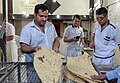 Sangak
 -
 Sangak
 -
Sangak
-
 Sangak
 -
 Sangak


.jpg)
.jpg)

.jpg)

