Mayfair: Difference between revisions
CSV import |
CSV import |
||
| Line 32: | Line 32: | ||
[[Category:Areas of London]] | [[Category:Areas of London]] | ||
[[Category:Mayfair]] | [[Category:Mayfair]] | ||
== Mayfair == | |||
<gallery> | |||
File:Grosvenor Square entrance.jpg|Grosvenor Square Entrance | |||
File:Grosvenor Square.JPG|Grosvenor Square | |||
File:Statue of Pitt the Younger, Hanover Square W1.JPG|Statue of Pitt the Younger, Hanover Square | |||
File:St George's Hanover Square by T Malton. 1787.jpg|St George's Hanover Square by T Malton, 1787 | |||
File:Sophie Snyder Berkeley Square.jpg|Sophie Snyder Berkeley Square | |||
File:Embassy of Italy, London.jpg|Embassy of Italy, London | |||
File:Saint George Church, Hanover Square.jpg|Saint George Church, Hanover Square | |||
File:Claridges Hotel - geograph.org.uk - 1064579.jpg|Claridge's Hotel | |||
File:Savile Row c. 1890.jpg|Savile Row c. 1890 | |||
File:Shepherd Market 1.jpg|Shepherd Market | |||
File:Burlington Arcade, shops - clean.jpg|Burlington Arcade, shops | |||
File:London 003 Hendrix and Handel houses.jpg|Hendrix and Handel houses | |||
</gallery> | |||
Latest revision as of 01:30, 20 February 2025


Mayfair is an affluent area in the West End of London, towards the eastern edge of Hyde Park, in the City of Westminster. It is one of the most expensive districts in London and the world. The area is primarily commercial with many former homes converted into offices for major corporate headquarters, embassies, and also includes residential buildings.
History[edit]
Mayfair takes its name from the annual fortnight-long May Fair that took place on the site that is now Shepherd Market (a small square in the Mayfair area) from 1686 to 1764. Originally a fashionable residential district for the wealthy, Mayfair has maintained its prestige over the centuries and has contained some of London's most exclusive luxury hotels, shops, and restaurants, as well as some of the city's most expensive residential properties.
Geography[edit]
Mayfair is bordered by Piccadilly to the south, Oxford Street to the north, Regent Street to the east, and Park Lane to the west. The area covers approximately 0.5 square miles (1.3 km²). Within Mayfair, there are several notable streets including Bond Street, known for its luxury shops and exclusive brands, and Savile Row, famous for its men's tailoring.
Economy[edit]
The economy of Mayfair has traditionally been dominated by its luxury hotels, retail, and real estate. The area is home to numerous embassies, hedge funds, and real estate firms. Retail spaces in Mayfair are among the most expensive in the world, with high-end fashion, rare antiques, and luxury goods available.
Culture and Society[edit]
Mayfair has a rich cultural heritage with several art galleries, auction houses, and museums. It hosts a variety of cultural events and exhibitions, attracting tourists and locals alike. The area is also known for its historic squares and parks, such as Grosvenor Square and Berkeley Square, which offer green spaces in the heart of the city.
Notable Buildings and Landmarks[edit]
- Burlington House, home to the Royal Academy of Arts - Claridge's, a famous luxury hotel - The Dorchester, another prestigious hotel - Grosvenor House Hotel - Handel & Hendrix in London, a museum dedicated to the lives and works of the composer George Frideric Handel and the guitarist Jimi Hendrix - The Ritz Hotel
Transport[edit]
Mayfair is well served by the London Underground, with stations such as Bond Street, Green Park, and Hyde Park Corner providing easy access to the rest of London. Despite its central location, Mayfair retains a quiet and exclusive atmosphere.
See Also[edit]
Mayfair[edit]
-
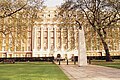 Grosvenor Square Entrance
 -
 Grosvenor Square
 -
 Statue of Pitt the Younger, Hanover Square
 -
 St George's Hanover Square by T Malton, 1787
 -
 Sophie Snyder Berkeley Square
 -
 Embassy of Italy, London
 -
 Saint George Church, Hanover Square
 -
 Claridge's Hotel
 -
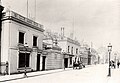 Savile Row c. 1890
 -
 Shepherd Market
 -
 Burlington Arcade, shops
 -
 Hendrix and Handel houses


