Radio: Difference between revisions
CSV import Tags: mobile edit mobile web edit |
CSV import |
||
| Line 37: | Line 37: | ||
{{stub}} | {{stub}} | ||
<gallery> | |||
File:Radio towers on Sandia Peak - closeup.jpg|Radio towers on Sandia Peak | |||
File:Signal processing system.png|Signal processing system | |||
File:Amfm3-en-de.gif|AM/FM modulation | |||
File:Modulated radio signal frequency spectrum.svg|Modulated radio signal frequency spectrum | |||
File:Portable radio receiving DAB%2B transmission in UK.jpg|Portable radio receiving DAB+ transmission | |||
File:SiriusXM Display on Volkswagen's RNS-510 Receiver.png|SiriusXM display on Volkswagen's RNS-510 receiver | |||
File:Satellite TV diagram.png|Satellite TV diagram | |||
File:Zivile Satellitentelefone.jpg|Civilian satellite telephones | |||
File:Portable radio SCR536.png|Portable radio SCR-536 | |||
File:Miramar Fire Department Firefighters Conduct Prescribed Burns 140612-M-RB277-066.jpg|Firefighters conducting prescribed burns | |||
File:Maritime VHF Sailor type.jpg|Maritime VHF radio | |||
File:Wireless network.jpg|Wireless network | |||
</gallery> | |||
Latest revision as of 01:29, 20 February 2025
Radio is a technology that allows for the transmission of signals by modulation of electromagnetic waves. These waves, which are not required to travel through a specific medium, can pass through the air in a process known as wireless communication.
History[edit]
The concept of radio waves was first predicted by mathematical work done in 1867 by Scottish physicist James Clerk Maxwell. His mathematical theory, now known as Maxwell's equations, predicted that a coupled electric and magnetic field could travel through space as an "electromagnetic wave". Radio technology was further developed by multiple inventors and scientists including Nikola Tesla, Guglielmo Marconi, and Alexander Popov.
Types of Radio Broadcasting[edit]
There are several types of radio broadcasting systems, including AM and FM radio, shortwave radio, and digital radio. Each of these systems uses a different method of modulation to carry information on the radio wave.
AM and FM Radio[edit]
AM radio, or Amplitude Modulation, varies the strength of the carrier wave to create the signal, while FM radio, or Frequency Modulation, varies the frequency of the carrier wave.
Shortwave Radio[edit]
Shortwave radio operates on frequencies just above the AM radio band, and is capable of long-distance transmission due to the way the radio waves are reflected back to Earth from the ionosphere.
Digital Radio[edit]
Digital radio is a type of radio broadcasting that uses digital technology to transmit and/or receive across the radio spectrum.
Uses of Radio[edit]
Radio technology is used in a wide range of applications, including broadcasting, telecommunications, emergency services communication, and wireless computer networks.
See Also[edit]
 | |
|---|---|
 |
 |
-
 Radio towers on Sandia Peak
 -
 Signal processing system
 -
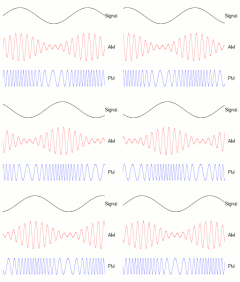 AM/FM modulation
 -
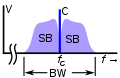 Modulated radio signal frequency spectrum
 -
 Portable radio receiving DAB+ transmission
 -
 SiriusXM display on Volkswagen's RNS-510 receiver
 -
 Satellite TV diagram
 -
 Civilian satellite telephones
 -
 Portable radio SCR-536
 -
 Firefighters conducting prescribed burns
 -
 Maritime VHF radio
 -
 Wireless network


