Rhytidectomy: Difference between revisions
CSV import Tags: mobile edit mobile web edit |
CSV import |
||
| Line 28: | Line 28: | ||
{{stub}} | {{stub}} | ||
== Rhytidectomy == | |||
<gallery> | |||
File:Mid facelift (rhytidectomy) upper incision.png|Mid facelift (rhytidectomy) upper incision | |||
File:Mid facelift (rhytidectomy) lower incision.png|Mid facelift (rhytidectomy) lower incision | |||
File:Distance cilliary margin orbicularis oculi.jpg|Distance cilliary margin orbicularis oculi | |||
File:Ageing of the human face.jpg|Ageing of the human face | |||
File:Head nerves.gif|Head nerves | |||
File:Head arteries.gif|Head arteries | |||
File:SMAS Facelift.jpg|SMAS Facelift | |||
File:Facelift incisions and undermining of different procedures.jpg|Facelift incisions and undermining of different procedures | |||
</gallery> | |||
Latest revision as of 01:23, 20 February 2025
Rhytidectomy, also known as a facelift, is a type of cosmetic surgery procedure used to give a more youthful appearance. It usually involves the removal of excess facial skin, with or without the tightening of underlying tissues, and the redraping of the skin on the patient's face and neck.
Procedure[edit]
Rhytidectomy is performed to reduce the appearance of facial wrinkles and other telltale signs of aging, with the goal of improving the overall appearance of the face and jaw. Facelift surgery can help to reverse the harmful effects of time, stress, and exposure to the elements. To perform this procedure, a facial plastic surgeon will lift and tighten the underlying muscles of the face to create more aesthetically pleasing contours appearance and rejuvenate the facial structure. Then he or she will remove excess pockets of fat and skin that can contribute to an aged, tired appearance.
Types of Rhytidectomy[edit]
There are several types of facelifts, including the "skin only" facelift, the "SMAS" lift, the "deep plane facelift", and the "composite facelift". Each of these procedures has its own set of potential benefits and drawbacks, and the best choice will depend on the patient's individual needs and goals.
Risks and Complications[edit]
Like any surgery, rhytidectomy carries some risks. These may include infection, complications from anesthesia, hematoma, nerve injury, and poor cosmetic outcome. However, these risks can be minimized by choosing a qualified, board-certified plastic surgeon and by following all pre- and post-operative instructions.
Recovery[edit]
Recovery time will vary by patient and by the specific procedure performed. However, most patients can expect to return to normal activities within two weeks, with full recovery taking several months.
See Also[edit]
References[edit]
<references />
 | |
|---|---|
 |
 |
Rhytidectomy[edit]
-
 Mid facelift (rhytidectomy) upper incision
 -
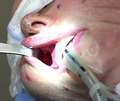 Mid facelift (rhytidectomy) lower incision
 -
 Distance cilliary margin orbicularis oculi
 -
 Ageing of the human face
 -
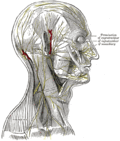 Head nerves
 -
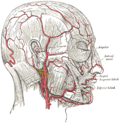 Head arteries
 -
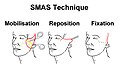 SMAS Facelift
 -
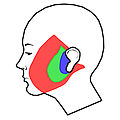 Facelift incisions and undermining of different procedures
_upper_incision.png)
_lower_incision.png)


