Montana: Difference between revisions
CSV import |
CSV import |
||
| Line 25: | Line 25: | ||
{{geography-stub}} | {{geography-stub}} | ||
{{history-stub}} | {{history-stub}} | ||
<gallery> | |||
File:State Song of Montana.ogg|State Song of Montana | |||
File:Early Indian treaty territories in Montana.png|Early Indian treaty territories in Montana | |||
File:Assinniboine2.jpg|Assinniboine | |||
File:Montana Territory 1865.jpg|Montana Territory 1865 | |||
File:Chief Joseph and Col. John Gibbon.jpg|Chief Joseph and Col. John Gibbon | |||
File:Buffalo soldiers1.jpg|Buffalo soldiers | |||
File:18891109 Montana statehood granted - The Helena Independent.png|Montana statehood granted - The Helena Independent | |||
File:18891109 We Crow for Montana - The Butte Daily Miner.jpg|We Crow for Montana - The Butte Daily Miner | |||
File:Mennonite family in Montana 1937.jpg|Mennonite family in Montana 1937 | |||
File:Montana Map.jpg|Montana Map | |||
</gallery> | |||
Latest revision as of 01:21, 20 February 2025
Montana is a state in the United States located in the western region of the country. Known for its diverse terrain, Montana is home to numerous mountain ranges, prairies, and forests, earning it the nickname "The Treasure State."
Geography[edit]
Montana is the fourth largest state by area in the United States, covering approximately 147,040 square miles. It is bordered by Idaho to the west, Wyoming and South Dakota to the south, and North Dakota to the east. To the north, Montana shares an international border with the Canadian provinces of British Columbia, Alberta, and Saskatchewan.
The state's diverse terrain includes the Rocky Mountains, the Great Plains, and numerous bodies of water such as Flathead Lake, the largest natural freshwater lake in the western United States. Montana's highest point is Granite Peak, which stands at 12,799 feet.
History[edit]
Montana's history is marked by the influence of Native American tribes such as the Crow, Cheyenne, and Blackfeet. The area was later explored by European settlers during the Lewis and Clark Expedition in the early 19th century. Montana became a state on November 8, 1889.
Economy[edit]
Montana's economy is primarily based on agriculture, including the production of wheat, barley, sugar beets, and cattle ranching. Other significant sectors include mining, with the state being a major producer of coal, gold, and talc, and tourism, with millions of visitors each year attracted to sites such as Glacier National Park and Yellowstone National Park.
Demographics[edit]
As of 2020, Montana has a population of approximately 1.08 million people. The state's largest city is Billings, and the capital is Helena.
Culture[edit]
Montana's culture is influenced by its history and geography. The state is known for its outdoor recreational activities such as fishing, hunting, hiking, and skiing. Montana also hosts several cultural events and festivals, including the Montana Folk Festival and the American Indian Council Powwow.


-
 State Song of Montana
 -
 Early Indian treaty territories in Montana
 -
 Assinniboine
 -
 Montana Territory 1865
 -
 Chief Joseph and Col. John Gibbon
 -
 Buffalo soldiers
 -
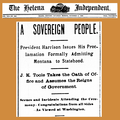 Montana statehood granted - The Helena Independent
 -
 We Crow for Montana - The Butte Daily Miner
 -
 Mennonite family in Montana 1937
 -
 Montana Map


