Polymerase chain reaction: Difference between revisions
No edit summary |
CSV import |
||
| (One intermediate revision by the same user not shown) | |||
| Line 1: | Line 1: | ||
'''Polymerase Chain Reaction''' (PCR) is a widely used [[laboratory]] technique in [[molecular biology]] to amplify a single copy or a few copies of a segment of [[DNA]] across several orders of magnitude, generating thousands to millions of copies of a particular DNA sequence. Developed in 1983 by [[Kary Mullis]], PCR is now a common and often indispensable technique used in medical and biological research labs for a variety of applications. | |||
[[ | |||
==Overview== | |||
PCR enables the selective amplification of a specific region of DNA from a complex pool of DNA. The process relies on thermal cycling, consisting of cycles of repeated heating and cooling of the reaction for DNA melting and enzymatic replication of the DNA. Primers (short DNA fragments) containing sequences complementary to the target region along with a DNA polymerase (after which the method is named) are key components to enable selective and repetitive amplification. | |||
=== | ==Process== | ||
The PCR process generally involves several key steps: | |||
# '''Denaturation''': The double-stranded DNA is heated to a high temperature to separate it into two single strands. | |||
# '''Annealing''': Temperature is lowered to enable the DNA primers to attach to the template DNA. | |||
# '''Extension''': DNA polymerase synthesizes a new DNA strand complementary to the DNA template strand by adding dNTPs (deoxynucleoside triphosphates) in a sequence dictated by the DNA template and primers. | |||
This cycle is typically repeated 25-35 times to produce the required quantity of DNA. | |||
==Applications== | |||
* | PCR has a broad range of applications including: | ||
* | * [[Genetic testing]]: Identifying genetic disorders from small samples of DNA. | ||
* | * [[Forensic science]]: Amplifying DNA from crime scene evidence. | ||
* | * [[Infectious disease]]: Detecting the presence of pathogen DNA in blood or tissues. | ||
* [[Research]]: Cloning DNA sequences and generating probes for Southern blotting. | |||
=== | ==Variations== | ||
Several variations of PCR exist, including: | |||
* '''Real-Time PCR''' or Quantitative PCR (qPCR): Allows quantitative measurement of DNA. | |||
* '''Reverse Transcription PCR''' (RT-PCR): Used for amplifying DNA from [[RNA]]. | |||
* '''Multiplex PCR''': Allows amplification of multiple targets in a single PCR setup. | |||
PCR | ==Challenges and Limitations== | ||
While PCR is a powerful and versatile tool, it is not without limitations. These include the potential for contamination leading to false results, the need for precise thermal cycling, and limitations in the size of DNA that can be amplified. | |||
==See Also== | |||
== See | |||
* [[DNA sequencing]] | * [[DNA sequencing]] | ||
* [[ | * [[Molecular cloning]] | ||
* [[ | * [[Gene expression]] | ||
[[ | [[Category:Molecular biology]] | ||
[ | [[Category:Biotechnology]] | ||
[[Category:DNA]] | |||
[[Category:Genetics]] | |||
{{medicine-stub}} | |||
<gallery> | |||
File:PCR tubes.png|Polymerase chain reaction | |||
File:PCR masina kasutamine.jpg|Polymerase chain reaction | |||
File:Primitive PCR machine for scrap.JPG|Polymerase chain reaction | |||
File:Polymerase chain reaction-en.svg|Polymerase chain reaction | |||
File:Roland Gel.JPG|Polymerase chain reaction | |||
File:Tucker PCR.png|Polymerase chain reaction | |||
File:Exponential Amplification.svg|Polymerase chain reaction | |||
File:Pcr fingerprint.png|Polymerase chain reaction | |||
File:US Army CID agents at crime scene.jpg|Polymerase chain reaction | |||
File:Primers RevComp.svg|Polymerase chain reaction | |||
File:Baby Blue - a prototype polymerase chain reaction (PCR), c 1986. (9663810586).jpg|Polymerase chain reaction | |||
</gallery> | |||
Latest revision as of 01:15, 20 February 2025
Polymerase Chain Reaction (PCR) is a widely used laboratory technique in molecular biology to amplify a single copy or a few copies of a segment of DNA across several orders of magnitude, generating thousands to millions of copies of a particular DNA sequence. Developed in 1983 by Kary Mullis, PCR is now a common and often indispensable technique used in medical and biological research labs for a variety of applications.
Overview[edit]
PCR enables the selective amplification of a specific region of DNA from a complex pool of DNA. The process relies on thermal cycling, consisting of cycles of repeated heating and cooling of the reaction for DNA melting and enzymatic replication of the DNA. Primers (short DNA fragments) containing sequences complementary to the target region along with a DNA polymerase (after which the method is named) are key components to enable selective and repetitive amplification.
Process[edit]
The PCR process generally involves several key steps:
- Denaturation: The double-stranded DNA is heated to a high temperature to separate it into two single strands.
- Annealing: Temperature is lowered to enable the DNA primers to attach to the template DNA.
- Extension: DNA polymerase synthesizes a new DNA strand complementary to the DNA template strand by adding dNTPs (deoxynucleoside triphosphates) in a sequence dictated by the DNA template and primers.
This cycle is typically repeated 25-35 times to produce the required quantity of DNA.
Applications[edit]
PCR has a broad range of applications including:
- Genetic testing: Identifying genetic disorders from small samples of DNA.
- Forensic science: Amplifying DNA from crime scene evidence.
- Infectious disease: Detecting the presence of pathogen DNA in blood or tissues.
- Research: Cloning DNA sequences and generating probes for Southern blotting.
Variations[edit]
Several variations of PCR exist, including:
- Real-Time PCR or Quantitative PCR (qPCR): Allows quantitative measurement of DNA.
- Reverse Transcription PCR (RT-PCR): Used for amplifying DNA from RNA.
- Multiplex PCR: Allows amplification of multiple targets in a single PCR setup.
Challenges and Limitations[edit]
While PCR is a powerful and versatile tool, it is not without limitations. These include the potential for contamination leading to false results, the need for precise thermal cycling, and limitations in the size of DNA that can be amplified.
See Also[edit]

-
 Polymerase chain reaction
 -
 Polymerase chain reaction
 -
 Polymerase chain reaction
 -
 Polymerase chain reaction
 -
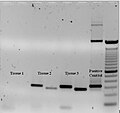 Polymerase chain reaction
 -
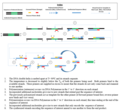 Polymerase chain reaction
 -
 Polymerase chain reaction
 -
 Polymerase chain reaction
 -
 Polymerase chain reaction
 -
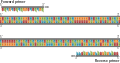 Polymerase chain reaction
 -
 Polymerase chain reaction


,_c_1986._(9663810586).jpg)
