Contact lens: Difference between revisions
CSV import |
CSV import |
||
| Line 27: | Line 27: | ||
{{stub}} | {{stub}} | ||
== Contact lens == | |||
<gallery> | |||
File:Contactlenzen Confortissimo.JPG|Contactlenzen Confortissimo | |||
File:ColorContactLens.JPG|Color Contact Lens | |||
File:Da Vinci's method of corneal neutralization.jpg|Da Vinci's method of corneal neutralization | |||
File:Adolf Fick-adjust.png|Adolf Fick | |||
File:Prof. Ing. RTDr. Otto Wichterle.jpg|Prof. Ing. RTDr. Otto Wichterle | |||
File:Contact Grain.jpg|Contact Grain | |||
File:Scleral lens worn on an eye.jpg|Scleral lens worn on an eye | |||
File:Eye with contact lens.jpg|Eye with contact lens | |||
File:Siliconehydrogel.svg|Silicone hydrogel | |||
File:Lens Basecurve.jpg|Lens Basecurve | |||
File:Contact Lens Wiki 2 3.webm|Contact Lens Wiki 2 3 | |||
File:Lens-cover.jpg|Lens cover | |||
</gallery> | |||
Latest revision as of 00:52, 20 February 2025
Contact lens are thin lenses placed directly on the surface of the eye. They are ocular prosthetic devices used by over 150 million people worldwide, and they can be worn to correct vision, for cosmetic, and therapeutic reasons. In 2004, it was estimated that 125 million people worldwide use contact lenses, including 28 to 38 million in the United States. In 2010, the worldwide market for contact lenses was estimated at $6.1 billion, while the US soft lens market was estimated at $2.1 billion.
Types of Contact Lenses[edit]
There are two general categories of contact lenses – soft and rigid gas permeable (RGP). Soft contact lenses are made of soft, flexible plastics that allow oxygen to pass through to the cornea. Rigid gas permeable contact lenses are more durable, resistant to deposit buildup, and generally give a clearer, crisper vision. They are often more breathable than are soft contact lenses, which means they are less likely to cause oxygen deprivation of the cornea.
Usage[edit]
Contact lenses are used for vision correction and are put on the cornea of the eye. They do provide a safe and effective way to correct vision when used with care and proper supervision. They can offer a good alternative to eyeglasses, depending on your eyes and lifestyle.
Risks[edit]
Some complications and conditions that can be caused by contact lenses are corneal ulcers and infections, conjunctivitis, allergic reaction, dry eyes, and others.
Care[edit]
Proper care for contact lenses includes cleaning them regularly, not sleeping in them, replacing them as directed, and following the same care regimen for storage cases.
See Also[edit]
- Eye care professional
- Vision correction
- Cornea
- Oxygen deprivation
- Conjunctivitis
- Allergic reaction
- Dry eyes
 | |
|---|---|
 |
 |
Contact lens[edit]
-
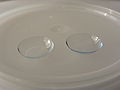 Contactlenzen Confortissimo
 -
 Color Contact Lens
 -
Da Vinci's method of corneal neutralization
-
 Adolf Fick
 -
 Prof. Ing. RTDr. Otto Wichterle
 -
 Contact Grain
 -
 Scleral lens worn on an eye
 -
 Eye with contact lens
 -
 Silicone hydrogel
 -
 Lens Basecurve
 -
 Contact Lens Wiki 2 3
 -
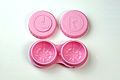 Lens cover


