Aurora: Difference between revisions
CSV import |
CSV import |
||
| Line 30: | Line 30: | ||
{{Geophysics-stub}} | {{Geophysics-stub}} | ||
== Aurora == | |||
<gallery> | |||
File:Aurora borealis over Eielson Air Force Base, Alaska.jpg|Aurora borealis over Eielson Air Force Base, Alaska | |||
File:Flames in the sky.jpg|Flames in the sky | |||
File:G5 aurora over Tuntorp, Lysekil Municipality 15.jpg|G5 aurora over Tuntorp, Lysekil Municipality | |||
File:Aurora australis ISS.jpg|Aurora australis from ISS | |||
File:Aurora Australis from ISS 2011 - 1.ogv|Aurora Australis from ISS 2011 | |||
File:Aurora Australis over Indian Ocean.ogv|Aurora Australis over Indian Ocean | |||
File:Aurora Australis south of Australia.ogv|Aurora Australis south of Australia | |||
File:Aurora Kp Map North America.gif|Aurora Kp Map North America | |||
File:Aurora Kp Map Eurasia.gif|Aurora Kp Map Eurasia | |||
</gallery> | |||
Latest revision as of 00:41, 20 February 2025


File:Spacecraft View of Aurora Australis from Space.webm


Aurora refers to a natural light display in the Earth's sky, predominantly seen in the high-latitude regions (around the Arctic and Antarctic). Auroras are the result of disturbances in the magnetosphere caused by the solar wind. These disturbances are sometimes strong enough to alter the trajectories of charged particles in both solar wind and magnetospheric plasma. These particles, mainly electrons and protons, precipitate into the upper atmosphere (thermosphere/exosphere). The resulting ionization and excitation of atmospheric constituents emit light of varying color and complexity. The light forms the aurora.
Types of Aurora[edit]
There are two main types of aurora: the Aurora Borealis, or Northern Lights, which occurs in the Northern Hemisphere, and the Aurora Australis, or Southern Lights, which occurs in the Southern Hemisphere.
Aurora Borealis[edit]
The Aurora Borealis is a spectacular natural phenomenon that can be observed in the sky over the northern parts of the world. It is most commonly seen in the Arctic region, including countries like Norway, Sweden, Finland, Iceland, Canada, and Alaska in the United States.
Aurora Australis[edit]
Similarly, the Aurora Australis graces the night skies of the Southern Hemisphere. It is best viewed from high southern latitudes, such as Antarctica, Chile, Argentina, New Zealand, and Australia.
Causes of Aurora[edit]
Auroras are caused by the interaction of the solar wind, a stream of charged particles emanating from the Sun, with the Earth's magnetic field and atmosphere. This interaction causes energetic particles to rain down into the atmosphere, colliding with gas molecules, such as oxygen and nitrogen, at high altitudes. The energy released during these collisions causes the atmospheric gases to glow, producing the beautiful lights of the aurora.
Colors of Aurora[edit]
The colors of the aurora are a result of the type of gas molecules that are colliding. The most common auroral color, a pale green, is produced by oxygen molecules located about 60 miles above the earth. Rare, all-red auroras are produced by high-altitude oxygen, at heights of up to 200 miles. Nitrogen produces blue or purplish-red aurora.
Observing the Aurora[edit]
The best time to observe the aurora is during the winter months in the respective hemispheres, during a period of high solar activity. The aurora tends to be most active late at night or early in the morning, and it can appear in many forms, from patches or scattered clouds of light to streamers, arcs, rippling curtains, or shooting rays that light up the sky with an eerie glow.
Cultural Significance[edit]
Auroras have had a significant impact on many cultures throughout history. Many indigenous peoples of the Arctic have myths and legends about the lights. In Norse mythology, the aurora was believed to be a bridge to the gods. Other cultures have seen them as the spirits of their ancestors or as harbingers of war or famine.
Scientific Study[edit]
The study of auroras is an important part of space weather and helps scientists understand the complex interactions between the sun and Earth's magnetosphere. Research into auroras helps improve our understanding of the solar wind, the Earth's magnetic field, and how the atmosphere can be affected by solar events.

This article is a geophysics-related stub. You can help WikiMD by expanding it!
Aurora[edit]
-
 Aurora borealis over Eielson Air Force Base, Alaska
 -
 Flames in the sky
 -
 G5 aurora over Tuntorp, Lysekil Municipality
 -
 Aurora australis from ISS
 -
 Aurora Australis from ISS 2011
 -
Aurora Australis over Indian Ocean
-
Aurora Australis south of Australia
-
 Aurora Kp Map North America
 -
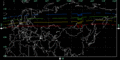 Aurora Kp Map Eurasia


