Alveolate: Difference between revisions
CSV import |
CSV import Tags: mobile edit mobile web edit |
||
| Line 8: | Line 8: | ||
File:Dinophysis_acuminata.jpg|Dinophysis acuminata | File:Dinophysis_acuminata.jpg|Dinophysis acuminata | ||
</gallery> | </gallery> | ||
== Alveolate == | |||
Alveolates are a group of protists characterized by the presence of alveoli, which are small sacs or vesicles located just beneath the cell membrane. This group is part of the larger clade known as the [[Chromalveolata]], which also includes other protists such as [[stramenopiles]]. Alveolates are highly diverse and include important groups such as [[dinoflagellates]], [[apicomplexans]], and [[ciliates]]. | |||
=== Characteristics === | |||
Alveolates are defined by the presence of alveoli, which are flattened vesicles that support the cell membrane. These structures are thought to provide structural support and may play a role in osmoregulation. Alveolates typically have complex cell structures and life cycles, often involving multiple stages and forms. | |||
=== Major Groups === | |||
==== Dinoflagellates ==== | |||
[[Dinoflagellates]] are a group of mostly marine plankton, but they are also common in freshwater habitats. They are known for their two distinct flagella, which allow them to move in a spinning motion. Dinoflagellates are important primary producers in aquatic ecosystems and are known for causing harmful algal blooms, such as red tides. | |||
==== Apicomplexans ==== | |||
[[Apicomplexans]] are a group of parasitic alveolates that include important pathogens such as [[Plasmodium]], the causative agent of malaria, and [[Toxoplasma gondii]], which causes toxoplasmosis. They are characterized by a unique organelle called the apicoplast, which is involved in the invasion of host cells. | |||
==== Ciliates ==== | |||
[[Ciliates]] are a diverse group of alveolates that are characterized by the presence of hair-like structures called cilia, which they use for movement and feeding. Ciliates are found in a variety of environments, including freshwater, marine, and soil habitats. They have complex cell structures, often with two types of nuclei: a macronucleus and one or more micronuclei. | |||
=== Evolution and Phylogeny === | |||
Alveolates are believed to have evolved from a common ancestor with other [[Chromalveolata]], and they share a number of genetic and structural features with other members of this clade. Molecular studies have helped to clarify the relationships between the different groups of alveolates, although their exact evolutionary history is still a subject of research. | |||
=== Ecological Importance === | |||
Alveolates play crucial roles in their ecosystems. Dinoflagellates are key primary producers in marine environments, contributing to the base of the food web. Apicomplexans, while often pathogenic, are important for understanding host-parasite interactions and the evolution of parasitism. Ciliates are important in nutrient cycling and as prey for larger organisms. | |||
== Related Pages == | |||
* [[Chromalveolata]] | |||
* [[Protist]] | |||
* [[Plasmodium]] | |||
* [[Toxoplasma gondii]] | |||
* [[Red tide]] | |||
{{Protists}} | |||
[[Category:Alveolates]] | |||
[[Category:Chromalveolata]] | |||
[[Category:Protists]] | |||
Latest revision as of 00:40, 19 February 2025
-
 Ceratium furca
 -
 Alveoli in ciliate Paramecium putrinum
 -
 Paramecium caudatum
 -
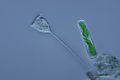 Glockentierchen
 -
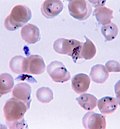 Plasmodium
 -
Eimeria maxima oocysts
-
Dinophysis acuminata


Alveolate[edit]
Alveolates are a group of protists characterized by the presence of alveoli, which are small sacs or vesicles located just beneath the cell membrane. This group is part of the larger clade known as the Chromalveolata, which also includes other protists such as stramenopiles. Alveolates are highly diverse and include important groups such as dinoflagellates, apicomplexans, and ciliates.
Characteristics[edit]
Alveolates are defined by the presence of alveoli, which are flattened vesicles that support the cell membrane. These structures are thought to provide structural support and may play a role in osmoregulation. Alveolates typically have complex cell structures and life cycles, often involving multiple stages and forms.
Major Groups[edit]
Dinoflagellates[edit]
Dinoflagellates are a group of mostly marine plankton, but they are also common in freshwater habitats. They are known for their two distinct flagella, which allow them to move in a spinning motion. Dinoflagellates are important primary producers in aquatic ecosystems and are known for causing harmful algal blooms, such as red tides.
Apicomplexans[edit]
Apicomplexans are a group of parasitic alveolates that include important pathogens such as Plasmodium, the causative agent of malaria, and Toxoplasma gondii, which causes toxoplasmosis. They are characterized by a unique organelle called the apicoplast, which is involved in the invasion of host cells.
Ciliates[edit]
Ciliates are a diverse group of alveolates that are characterized by the presence of hair-like structures called cilia, which they use for movement and feeding. Ciliates are found in a variety of environments, including freshwater, marine, and soil habitats. They have complex cell structures, often with two types of nuclei: a macronucleus and one or more micronuclei.
Evolution and Phylogeny[edit]
Alveolates are believed to have evolved from a common ancestor with other Chromalveolata, and they share a number of genetic and structural features with other members of this clade. Molecular studies have helped to clarify the relationships between the different groups of alveolates, although their exact evolutionary history is still a subject of research.
Ecological Importance[edit]
Alveolates play crucial roles in their ecosystems. Dinoflagellates are key primary producers in marine environments, contributing to the base of the food web. Apicomplexans, while often pathogenic, are important for understanding host-parasite interactions and the evolution of parasitism. Ciliates are important in nutrient cycling and as prey for larger organisms.
Related Pages[edit]
| Protists | ||||||||||
|---|---|---|---|---|---|---|---|---|---|---|
|


