Armillaria tabescens: Difference between revisions
CSV import |
CSV import |
||
| Line 3: | Line 3: | ||
File:2008-07-16_Armillaria_tabescens_cropped.jpg|Armillaria tabescens | File:2008-07-16_Armillaria_tabescens_cropped.jpg|Armillaria tabescens | ||
</gallery> | </gallery> | ||
== Armillaria tabescens == | |||
'''Armillaria tabescens''', commonly known as the ringless honey mushroom, is a species of [[fungus]] in the family [[Physalacriaceae]]. It is a pathogenic fungus that primarily affects [[woody plants]], causing a disease known as [[Armillaria root rot]]. | |||
== Description == | |||
''Armillaria tabescens'' is characterized by its lack of an [[annulus (mycology)|annulus]], or ring, on the [[stipe (mycology)|stipe]], which distinguishes it from other species in the genus ''[[Armillaria]]''. The [[cap (mycology)|cap]] is typically 3–10 cm in diameter, convex to flat, and varies in color from tan to brown. The [[gills]] are white to cream-colored and are attached to the stipe. The stipe itself is 5–15 cm long and 0.5–2 cm thick, often tapering towards the base. | |||
== Habitat and Distribution == | |||
''Armillaria tabescens'' is found in [[temperate]] regions, particularly in [[North America]], [[Europe]], and parts of [[Asia]]. It grows in clusters on the ground, often near decaying [[wood]] or on the roots of living trees. This species is most commonly found in [[forests]] and [[woodlands]], but it can also appear in [[urban]] and [[suburban]] areas where suitable hosts are present. | |||
== Life Cycle and Ecology == | |||
The life cycle of ''Armillaria tabescens'' involves both [[sexual reproduction|sexual]] and [[asexual reproduction|asexual]] stages. The fungus produces [[basidiospores]] on its gills, which are dispersed by the wind. These spores germinate to form [[mycelium]], which can infect the roots of susceptible plants. The mycelium can spread through the soil, infecting other nearby plants. | |||
''Armillaria tabescens'' is a [[saprotroph]] and a [[necrotroph]], meaning it can decompose dead organic matter and also infect living plants, causing [[disease]]. It is known to cause significant damage to [[forestry|forests]] and [[horticulture|horticultural]] crops by killing trees and shrubs. | |||
== Symptoms and Management == | |||
Infected plants exhibit symptoms such as [[wilting]], [[leaf]] [[chlorosis]], and [[dieback]]. The presence of white [[mycelial fans]] under the bark and [[rhizomorphs]] in the soil are indicative of ''Armillaria'' infection. Management of ''Armillaria tabescens'' involves cultural practices such as removing infected stumps and roots, improving soil drainage, and selecting resistant plant species. | |||
== Related Pages == | |||
* [[Armillaria]] | |||
* [[Fungal plant pathogens]] | |||
* [[Mycology]] | |||
* [[Forest pathology]] | |||
{{Fungi}} | |||
[[Category:Fungi]] | |||
[[Category:Plant pathogens and diseases]] | |||
[[Category:Armillaria]] | |||
Latest revision as of 00:39, 19 February 2025
-
 Armillaria tabescens
 -
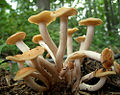 Armillaria tabescens


Armillaria tabescens[edit]
Armillaria tabescens, commonly known as the ringless honey mushroom, is a species of fungus in the family Physalacriaceae. It is a pathogenic fungus that primarily affects woody plants, causing a disease known as Armillaria root rot.
Description[edit]
Armillaria tabescens is characterized by its lack of an annulus, or ring, on the stipe, which distinguishes it from other species in the genus Armillaria. The cap is typically 3–10 cm in diameter, convex to flat, and varies in color from tan to brown. The gills are white to cream-colored and are attached to the stipe. The stipe itself is 5–15 cm long and 0.5–2 cm thick, often tapering towards the base.
Habitat and Distribution[edit]
Armillaria tabescens is found in temperate regions, particularly in North America, Europe, and parts of Asia. It grows in clusters on the ground, often near decaying wood or on the roots of living trees. This species is most commonly found in forests and woodlands, but it can also appear in urban and suburban areas where suitable hosts are present.
Life Cycle and Ecology[edit]
The life cycle of Armillaria tabescens involves both sexual and asexual stages. The fungus produces basidiospores on its gills, which are dispersed by the wind. These spores germinate to form mycelium, which can infect the roots of susceptible plants. The mycelium can spread through the soil, infecting other nearby plants.
Armillaria tabescens is a saprotroph and a necrotroph, meaning it can decompose dead organic matter and also infect living plants, causing disease. It is known to cause significant damage to forests and horticultural crops by killing trees and shrubs.
Symptoms and Management[edit]
Infected plants exhibit symptoms such as wilting, leaf chlorosis, and dieback. The presence of white mycelial fans under the bark and rhizomorphs in the soil are indicative of Armillaria infection. Management of Armillaria tabescens involves cultural practices such as removing infected stumps and roots, improving soil drainage, and selecting resistant plant species.
