Yogachara: Difference between revisions
CSV import |
CSV import |
||
| Line 39: | Line 39: | ||
{{Buddhism-stub}} | {{Buddhism-stub}} | ||
<gallery> | |||
File:TheFutureBuddhaGandhara3rdCentury.jpg|The Future Buddha, Gandhara, 3rd Century | |||
File:Muchaku_Hokuendo_Kofukuji_2.jpg|Muchaku, Hokuendo, Kofukuji | |||
File:Seshin_(Unkei)_Hokuendo_Kofukuji.jpg|Seshin (Unkei), Hokuendo, Kofukuji | |||
File:Vikramashila_University.jpg|Vikramashila University | |||
File:Xuan_Zang_Statue.jpg|Xuan Zang Statue | |||
File:Jion_Daishi.jpg|Jion Daishi | |||
File:Rangjung_Dorje.jpg|Rangjung Dorje | |||
File:Xuanzang_Memorial_Hall_%28Wall_Painting%29.JPG|Xuanzang Memorial Hall (Wall Painting) | |||
File:Asanga.JPG|Asanga | |||
</gallery> | |||
Latest revision as of 12:22, 18 February 2025
Yogachara (also spelled Yogācāra) is a school of Buddhism that developed in India during the 4th to 5th century CE. The term Yogachara means "practice of yoga" or "one whose practice is yoga". This school is also known as Vijnanavada (the doctrine of consciousness), Vijnaptimatra (representation-only), and Cittamatra (mind-only) in scholarly and historical texts.
History[edit]
The Yogachara school was founded by the brothers Asanga and Vasubandhu, who were originally Mahayana Buddhists. They were influenced by the teachings of the Mahayana Sutras and the Buddha-nature doctrine of the Tathagatagarbha Sutras. The school's doctrines were further developed and systematized by the later scholars Dignaga and Dharmakirti.
Philosophy[edit]
Yogachara is primarily a philosophy of mind and consciousness. It asserts that all phenomena are phenomena of the mind, which are created by our perceptions and cognitive processes. This is often summarized by the phrase "all is mind" or "all is consciousness".
The school's main philosophical teachings are the Three Natures and the Eight Consciousnesses. The Three Natures are the Imaginary Nature (parikalpita), the Dependent Nature (paratantra), and the Absolute Nature (parinishpanna). The Eight Consciousnesses are the five sense consciousnesses, the mind consciousness, the defiled mental consciousness, and the storehouse consciousness.
Practices[edit]
The practices of Yogachara include meditation, mindfulness, and yoga. These practices are aimed at realizing the true nature of mind and phenomena, and achieving enlightenment.
Influence[edit]
Yogachara has had a significant influence on various forms of Buddhism, including Tibetan Buddhism and East Asian Buddhism. It has also influenced various philosophical and psychological theories in the West.
See also[edit]
References[edit]
<references />
| Buddhism |
|---|
|
[[File:
 |200px|center|alt=]] |200px|center|alt=]]
|
| Mahayana Buddhism | ||||||||||
|---|---|---|---|---|---|---|---|---|---|---|
This Mahayana Buddhism related article is a stub.
|
| Buddhist meditation | ||||||||||
|---|---|---|---|---|---|---|---|---|---|---|
This Buddhist meditation related article is a stub.
|

-
 The Future Buddha, Gandhara, 3rd Century
 -
 Muchaku, Hokuendo, Kofukuji
 -
 Seshin (Unkei), Hokuendo, Kofukuji
 -
 Vikramashila University
 -
 Xuan Zang Statue
 -
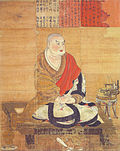 Jion Daishi
 -
 Rangjung Dorje
 -
 Xuanzang Memorial Hall (Wall Painting)
 -
 Asanga


_Hokuendo_Kofukuji.jpg)


.JPG)

