London Ambulance Service: Difference between revisions
CSV import Tags: mobile edit mobile web edit |
CSV import |
||
| Line 26: | Line 26: | ||
{{UK-emergency-service-stub}} | {{UK-emergency-service-stub}} | ||
<gallery> | |||
File:London_Ambulance_Service_Logo.svg|London Ambulance Service Logo | |||
File:Ministry_of_Information_First_World_War_Official_Collection_Q31103.jpg|Ministry of Information First World War Official Collection | |||
File:The_Reconstruction_of_'an_Incident'-_Civil_Defence_Training_in_Fulham,_London,_1942_D7917.jpg|Civil Defence Training in Fulham, London, 1942 | |||
File:London_Ambulance_vehicles.jpg|London Ambulance Vehicles | |||
File:LAS_at_St_Georges_(cropped).jpg|LAS at St George's | |||
File:London_Ambulance_Service_Volkswagen_Tiguan_Fast_Response_Unit_at_Wembly.jpg|London Ambulance Service Volkswagen Tiguan Fast Response Unit at Wembley | |||
File:ST1300_Ambulance_Bike_in_London.jpg|ST1300 Ambulance Bike in London | |||
File:NHS_bicycle.jpg|NHS Bicycle | |||
File:Russell_square_ambulances.jpg|Russell Square Ambulances | |||
</gallery> | |||
Latest revision as of 12:18, 18 February 2025

London Ambulance Service (LAS) is the NHS trust responsible for operating ambulances and answering and responding to urgent and emergency medical situations within the London area of the United Kingdom. It is one of the busiest ambulance services in the world, and it is the largest free-at-the-point-of-use emergency ambulance service globally. The LAS was established in 1965 from nine former services and today it serves a population of over eight million people across an area of 620 square miles.
History[edit]
The London Ambulance Service was formed in 1965 by the amalgamation of nine existing services in the London area. Before this, ambulance services were managed by local hospitals or boroughs, leading to a fragmented system. The creation of the LAS was part of a wider move to bring ambulance services under the control of the NHS, ensuring a more coordinated and efficient response to emergencies.
Operations[edit]
The LAS operates out of its headquarters in Waterloo, central London, and has over 70 ambulance stations across the city. It employs around 5,000 staff, including paramedics, emergency medical technicians, and support staff. The service operates a fleet of over 500 ambulances, as well as rapid response vehicles, motorcycle units, and bicycle units for navigating through heavy traffic and crowded areas.
The LAS responds to over 1.9 million emergency calls a year, ranging from life-threatening conditions to minor injuries. It also provides a range of other services, including the Hazardous Area Response Team (HART), which deals with chemical, biological, radiological, and nuclear incidents, and the Air Ambulance service, operated in conjunction with the Charity Air Ambulance.
Training and Development[edit]
The London Ambulance Service places a strong emphasis on the training and development of its staff. It runs its own paramedic training programs in partnership with local universities, offering a mix of academic study and practical experience. The service also provides ongoing training and professional development opportunities for all its staff to ensure they are up to date with the latest medical practices and technologies.
Challenges[edit]
The LAS faces numerous challenges, including the high demand for its services, the vast and diverse area it covers, and the need to maintain high standards of care. The service has implemented several initiatives to address these challenges, such as the use of advanced technology to improve response times and the introduction of new roles, like the paramedic practitioner, to provide more specialized care in the community.
Community Engagement[edit]
The London Ambulance Service is committed to engaging with the communities it serves. It runs public awareness campaigns on issues such as the appropriate use of emergency services and the importance of CPR training. The service also works closely with local organizations and charities to improve health outcomes and reduce the demand for emergency services.
Future Directions[edit]
The LAS continues to evolve in response to the changing needs of the population it serves. Future directions include the further integration of technology in operations, the expansion of community-based care, and the development of new models of care to better meet the needs of patients with complex conditions.
This article is a UK emergency services-related stub. You can help WikiMD by expanding it!
-
London Ambulance Service Logo
-
 Ministry of Information First World War Official Collection
 -
 Civil Defence Training in Fulham, London, 1942
 -
 London Ambulance Vehicles
 -
 LAS at St George's
 -
 London Ambulance Service Volkswagen Tiguan Fast Response Unit at Wembley
 -
 ST1300 Ambulance Bike in London
 -
 NHS Bicycle
 -
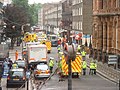 Russell Square Ambulances


.jpg)


