Magnetochemistry: Difference between revisions
CSV import |
CSV import |
||
| Line 34: | Line 34: | ||
{{physics-stub}} | {{physics-stub}} | ||
{{medicine-stub}} | {{medicine-stub}} | ||
<gallery> | |||
File:Gouy_bal.png|Gouy balance used to measure magnetic susceptibility | |||
File:Susceptibility.png|Graph of magnetic susceptibility | |||
File:Copper(II)-acetate-3D-balls2.png|3D model of Copper(II) acetate | |||
File:Ferrimagnetic_ordering.svg|Diagram of ferrimagnetic ordering | |||
File:Antiferromagnetic_ordering.svg|Diagram of antiferromagnetic ordering | |||
File:CFT-Low_Spin_Splitting_Diagram-Vector.svg|Crystal Field Theory low spin splitting diagram | |||
File:CFT-High_Spin_Splitting_Diagram-Vector.svg|Crystal Field Theory high spin splitting diagram | |||
File:EPR_methyl.png|Electron Paramagnetic Resonance of methyl radical | |||
File:MTSL_chemical_structure.png|Chemical structure of MTSL | |||
</gallery> | |||
Latest revision as of 12:12, 18 February 2025
Magnetochemistry is an area of chemistry that studies the magnetic properties of chemical compounds. This field is closely related to physical chemistry, quantum chemistry, and solid-state physics.
Overview[edit]
Magnetochemistry involves the study of the magnetic properties of chemical compounds. Magnetic properties arise from the spin and orbital angular momentum of the electrons. The phenomena involved in magnetochemistry are quite complex, with the simplest case being the lone pair electrons.
History[edit]
The field of magnetochemistry has its roots in the 19th century with the work of Michael Faraday and James Clerk Maxwell. Faraday discovered that the plane of polarization of light could be rotated by a magnetic field, a phenomenon now known as the Faraday effect. Maxwell's equations, which unify electricity and magnetism, also play a crucial role in understanding magnetochemical phenomena.
Magnetic Moments[edit]
The magnetic moment of a system measures the system's tendency to align with a magnetic field. In magnetochemistry, the magnetic moment is often determined by the spin and orbital angular momentum of the electrons.
Applications[edit]
Magnetochemistry has a wide range of applications, including in medicine, material science, and engineering. For example, magnetic resonance imaging (MRI) is a medical imaging technique used in radiology to form pictures of the anatomy and the physiological processes of the body.
See also[edit]
References[edit]
<references />


-
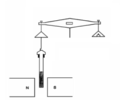 Gouy balance used to measure magnetic susceptibility
 -
Graph of magnetic susceptibility
-
 3D model of Copper(II) acetate
 -
 Diagram of ferrimagnetic ordering
 -
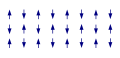 Diagram of antiferromagnetic ordering
 -
 Crystal Field Theory low spin splitting diagram
 -
 Crystal Field Theory high spin splitting diagram
 -
 Electron Paramagnetic Resonance of methyl radical
 -
 Chemical structure of MTSL

-acetate-3D-balls2.png)


