Phytoplasma: Difference between revisions
CSV import |
CSV import Tags: mobile edit mobile web edit |
||
| Line 22: | Line 22: | ||
{{Bacteria-stub}} | {{Bacteria-stub}} | ||
{{Plant-disease-stub}} | {{Plant-disease-stub}} | ||
<gallery> | |||
File:Vitis_vinifera_phytoplasma.jpg|Phytoplasma | |||
File:Flavescence_dorée_3.jpg|Phytoplasma | |||
File:Lethalyellowingpalms.jpg|Phytoplasma | |||
File:Asteryellowsmarigold.jpg|Phytoplasma | |||
File:TPWB1.tif|Phytoplasma | |||
File:Elmphloemnecrosis.jpg|Phytoplasma | |||
File:Brinjal_Little_leaf_phytoplasma.jpg|Phytoplasma | |||
File:Ashyellows.jpg|Phytoplasma | |||
File:Parthenium_hysterophorus_witches'_broom_phytoplasma.jpg|Phytoplasma | |||
File:Phyllody_on_Cosmos.jpg|Phytoplasma | |||
File:Little_leaf_disease_of_Cleome_viscosa.jpg|Phytoplasma | |||
File:Sweetpotatoelittleleaf.JPG|Phytoplasma | |||
</gallery> | |||
Latest revision as of 12:11, 18 February 2025
Phytoplasma are a genus of bacteria that lack a cell wall and are characterized by their small size and pleomorphic shape. They belong to the class Mollicutes, which includes other wall-less bacteria. Phytoplasmas are obligate parasites of plant phloem tissue and are transmitted by insect vectors, primarily by species of leafhoppers, planthoppers, and psyllids. These organisms are responsible for causing a wide range of plant diseases, which are collectively referred to as "phytoplasma diseases" or "yellows diseases" due to the yellowing symptoms often observed in infected plants.
Characteristics[edit]
Phytoplasmas are unique among bacteria due to their lack of a cell wall, which contributes to their pleomorphic shape, meaning they can vary in form. This characteristic makes them difficult to study and classify using traditional bacterial taxonomy methods. They range in size from 0.2 to 0.8 µm in diameter and are thus among the smallest bacterial pathogens capable of causing disease in plants. Phytoplasmas contain DNA, RNA, ribosomes, and a plasma membrane but lack many cellular structures found in other bacteria, such as flagella.
Life Cycle and Transmission[edit]
The life cycle of phytoplasmas involves two hosts: a plant host and an insect vector. Phytoplasmas reside in the phloem tissue of infected plants, where they are ingested by leafhoppers or other sap-sucking insects during feeding. Once inside the insect, the phytoplasmas multiply and eventually move to the salivary glands, from where they can be transmitted to other plants when the insect feeds again. This complex life cycle makes the control and management of phytoplasma diseases challenging.
Diseases Caused[edit]
Phytoplasmas are responsible for causing over 100 distinct plant diseases worldwide. Some of the most well-known diseases include Aster Yellows, Peach X-disease, Apple Proliferation, and Grapevine Yellows. Symptoms of phytoplasma infection can vary widely depending on the plant species and the specific phytoplasma involved but often include yellowing of leaves, stunted growth, abnormal floral organ development, and production of sterile flowers. These symptoms can lead to significant economic losses in agriculture and horticulture.
Diagnosis and Control[edit]
Diagnosing phytoplasma diseases is challenging due to the wide range of symptoms and the difficulty in culturing phytoplasmas in the laboratory. Molecular techniques, such as polymerase chain reaction (PCR), are commonly used to detect and identify phytoplasmas in infected plants and insect vectors. Control strategies for phytoplasma diseases focus on managing the insect vectors through the use of insecticides, planting resistant crop varieties, and implementing cultural practices that reduce the risk of infection.
Research and Importance[edit]
Research on phytoplasmas is focused on understanding their biology, transmission mechanisms, and interactions with host plants and insect vectors. This knowledge is crucial for developing effective management strategies for phytoplasma diseases. Phytoplasmas are of significant agricultural importance due to their impact on crop yields and quality. Understanding and controlling phytoplasma diseases is essential for ensuring food security and the sustainability of agricultural systems.


This article is a plant disease stub. You can help WikiMD by expanding it!
-
 Phytoplasma
 -
 Phytoplasma
 -
 Phytoplasma
 -
 Phytoplasma
 -
 Phytoplasma
 -
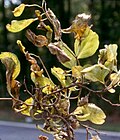 Phytoplasma
 -
 Phytoplasma
 -
 Phytoplasma
 -
 Phytoplasma
 -
 Phytoplasma
 -
 Phytoplasma
 -
 Phytoplasma


