Cellular automaton: Difference between revisions
CSV import |
CSV import Tags: mobile edit mobile web edit |
||
| Line 42: | Line 42: | ||
{{Physics-stub}} | {{Physics-stub}} | ||
{{Biology-stub}} | {{Biology-stub}} | ||
<gallery> | |||
File:Gospers_glider_gun.gif|Gosper's Glider Gun | |||
File:Torus.png|Torus | |||
File:Vonneumann-john_r.jpg|John von Neumann | |||
File:Oscillator.gif|Oscillator | |||
File:One-d-cellular-automate-rule-30.gif|One-dimensional Cellular Automaton Rule 30 | |||
File:CA_rule30s.png|Cellular Automaton Rule 30 | |||
File:Sample_run_of_Rule_110_elementary_cellular_automaton,_starting_from_single_cell.png|Sample Run of Rule 110 Elementary Cellular Automaton | |||
File:Textile_cone.JPG|Cellular Automaton | |||
File:Gas_velocity.gif|Gas Velocity | |||
</gallery> | |||
Latest revision as of 12:06, 18 February 2025
Cellular automaton (plural: cellular automata) is a discrete model studied in computational theory, mathematics, physics, complex systems, theoretical biology, and microstructure modeling. It consists of a grid of cells, each in one of a finite number of states, such as on or off. The grid can be in any finite number of dimensions. For each cell, a set of cells called its neighborhood is defined relative to the specified cell. An initial state (time t = 0) is selected by assigning a state for each cell. A new generation is created (advancing t by 1), according to some fixed rule (generally, a mathematical function) that determines the new state of each cell in terms of the current state of the cell and the states of the cells in its neighborhood. Typically, the rule for updating the state of cells is the same for each cell and does not change over time, and is applied to the whole grid simultaneously, though exceptions are known, such as the probabilistic cellular automata and asynchronous cellular automata.
History[edit]
The concept of cellular automata was originally discovered in the 1940s by Stanislaw Ulam and John von Neumann while they were working at the Los Alamos National Laboratory. Von Neumann was interested in creating a self-replicating system, which led to the development of cellular automata theory.
Types of Cellular Automata[edit]
There are many types of cellular automata, each defined by its rules, the state of its cells, and its neighborhood. The most common types include:
- Elementary Cellular Automata: These are one-dimensional cellular automata with two possible states for each cell and a neighborhood consisting of the cell itself and its two immediate neighbors.
- Conway's Game of Life: Perhaps the most famous cellular automaton, it is a two-dimensional automaton with cells in two possible states, alive or dead. The state of each cell in the next generation is determined by the current states of the cells in its eight-cell neighborhood according to a specific set of rules.
- Langton's Ant: A two-dimensional universal Turing machine with a very simple set of rules but complex emergent behavior.
- Wolfram's New Kind of Science (NKS): Stephen Wolfram's research into cellular automata and complex systems, proposing that cellular automata have applications in modeling natural phenomena.
Applications[edit]
Cellular automata have been used in various fields for modeling purposes, including:
- Computer Science: For the development of algorithms and data structures.
- Physics: To model physical systems, such as fluid dynamics and thermodynamics.
- Biology: To simulate biological systems, including the growth of plants and the development of cellular structures.
- Epidemiology: To model the spread of diseases.
- Cryptography: In the design of cryptographic systems.
See Also[edit]
References[edit]
<references />
| Conway's Game of Life and related cellular automata | ||||||||||
|---|---|---|---|---|---|---|---|---|---|---|
|
| Complex systems |
|---|
|
Topics
{{{content1}}}
|

This article is a mathematics-related stub. You can help WikiMD by expanding it!


-
 Gosper's Glider Gun
 -
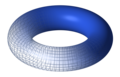 Torus
Torus -
 John von Neumann
 -
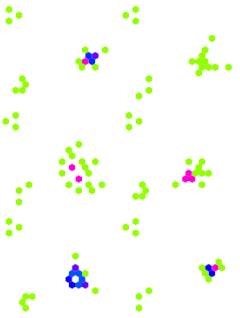 Oscillator
 -
 One-dimensional Cellular Automaton Rule 30
 -
 Cellular Automaton Rule 30
 -
 Sample Run of Rule 110 Elementary Cellular Automaton
 -
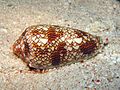 Cellular Automaton
 -
 Gas Velocity


