Intestinal villus: Difference between revisions
CSV import Tags: mobile edit mobile web edit |
CSV import |
||
| Line 17: | Line 17: | ||
[[Category:Anatomy]] | [[Category:Anatomy]] | ||
{{anatomy-stub}} | {{anatomy-stub}} | ||
<gallery> | |||
File:Small_intestine_low_mag.jpg|Intestinal villus | |||
File:Gray1058.png|Intestinal villus | |||
File:Gray1059.png|Intestinal villus | |||
File:Gray1060.png|Intestinal villus | |||
File:Cross-section_histology_of_small_intestinal_villi_of_the_terminal_ileum.jpg|Intestinal villus | |||
File:MCT_Chicken_jejunum_oblique.jpg|Intestinal villus | |||
File:MCT_Chicken_jejunum_horizontal_cut.jpg|Intestinal villus | |||
File:Intestinal_villus_simplified.svg|Intestinal villus | |||
File:Coeliac_Disease.png|Intestinal villus | |||
File:Nudemousejejunum_EM.jpg|Intestinal villus | |||
</gallery> | |||
Latest revision as of 12:01, 18 February 2025
Intestinal villus is a small, finger-like projection that extends into the lumen of the small intestine. Villi increase the internal surface area of the intestinal walls making available a greater surface area for absorption. Each villus is approximately 0.5-1.6 mm in length and has many microvilli, each of which further increases the surface area for absorption.
Structure[edit]
The intestinal villus is made up of a layer of simple columnar epithelium overlying a core of lamina propria, a loose connective tissue. The epithelial layer contains cells known as enterocytes, which are responsible for the absorption of nutrients. Interspersed among the enterocytes are goblet cells, which secrete mucus to lubricate the intestinal contents.
The lamina propria core contains a rich network of capillaries, which absorb sugars, amino acids, and other small molecules directly into the bloodstream. It also contains a lacteal, a lymphatic capillary, which absorbs fats and fat-soluble vitamins.
Function[edit]
The primary function of the intestinal villus is to increase the surface area of the intestine, enhancing its ability to absorb nutrients, electrolytes, and water from the digested food passing through the lumen. The villi and microvilli can increase the surface area of the small intestine by 30 times.
The enterocytes on the surface of the villi absorb nutrients through active transport and facilitated diffusion. The absorbed substances are then transported to the rest of the body through the circulatory and lymphatic systems.
Clinical significance[edit]
Damage to the intestinal villi can lead to malabsorption syndromes such as celiac disease, where the immune system attacks the villi in response to gluten ingestion, leading to nutrient malabsorption.

-
 Intestinal villus
 -
 Intestinal villus
 -
 Intestinal villus
 -
 Intestinal villus
 -
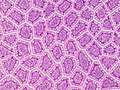 Intestinal villus
 -
 Intestinal villus
 -
 Intestinal villus
 -
 Intestinal villus
 -
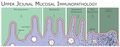 Intestinal villus
 -
 Intestinal villus


