John Struthers (anatomist): Difference between revisions
CSV import |
CSV import |
||
| Line 23: | Line 23: | ||
[[Category:University of Aberdeen faculty]] | [[Category:University of Aberdeen faculty]] | ||
{{medicine-stub}} | {{medicine-stub}} | ||
<gallery> | |||
File:John_Struthers_b1823.jpg|John Struthers (anatomist) | |||
File:Sir_John_Struthers_MD_formal_portrait_bow_tie_October_1890_Scotland.jpg|Sir John Struthers MD formal portrait, October 1890, Scotland | |||
File:Sir_John_Struthers_by_George_Reid_1891_painting.jpg|Sir John Struthers by George Reid, 1891 painting | |||
File:Ligament_of_Struthers_1854.jpg|Ligament of Struthers, 1854 | |||
File:Struthers_Tay_Whale_Dissection_by_George_Washington_Wilson.jpg|Struthers Tay Whale Dissection by George Washington Wilson | |||
File:Megaptera_Longimana_2.jpg|Megaptera Longimana | |||
File:John_Struthers_family_tree.jpg|John Struthers family tree | |||
File:The_grave_of_Prof_John_Struthers,_Warriston_Cemetery,_Edinburgh.JPG|The grave of Prof John Struthers, Warriston Cemetery, Edinburgh | |||
</gallery> | |||
Latest revision as of 11:59, 18 February 2025
John Struthers (1823–1899) was a prominent Scottish anatomist and medical educator known for his contributions to the medical field, particularly in the study of anatomy. He served as the Regius Professor of Anatomy at the University of Aberdeen, a position that highlighted his expertise and dedication to the advancement of medical education and research.
Early Life and Education[edit]
John Struthers was born in 1823 in Aberdeen, Scotland. From a young age, he showed a keen interest in the sciences, which led him to pursue a career in medicine. He received his medical degree from the University of Edinburgh, where he was influenced by the teachings and works of notable figures in the medical field.
Career[edit]
After completing his education, Struthers embarked on a career that would see him make significant contributions to anatomy and medical education. He was appointed as the Regius Professor of Anatomy at the University of Aberdeen, a role in which he excelled and gained widespread recognition.
One of Struthers' most notable contributions was his research on the anatomy of the arm, particularly the muscles and ligaments. His work led to a better understanding of the anatomical structures of the arm and their functions, which had implications for both medical education and surgical practice.
In addition to his research, Struthers was also a dedicated educator. He was known for his innovative teaching methods, which included the use of detailed anatomical models and dissections to enhance the learning experience for his students. His efforts in education helped to train a generation of medical professionals who would go on to make their own contributions to the field.
Legacy[edit]
John Struthers' legacy in the field of anatomy and medical education is enduring. His research and teaching methods left a lasting impact on the study of anatomy, influencing both his contemporaries and future generations of medical professionals. The University of Aberdeen continues to honor his contributions, recognizing him as a key figure in its medical history.
Struthers was also known for his collection of anatomical specimens, which served as valuable teaching and research resources. These specimens are still considered important educational tools, demonstrating Struthers' lasting influence on the field of anatomy.
Death[edit]
John Struthers passed away in 1899, leaving behind a legacy of excellence in medical education and research. His contributions to the field of anatomy have made him a respected figure in the history of medicine, remembered for his dedication to advancing medical knowledge and education.

-
 John Struthers (anatomist)
 -
 Sir John Struthers MD formal portrait, October 1890, Scotland
 -
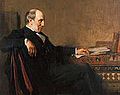 Sir John Struthers by George Reid, 1891 painting
 -
 Ligament of Struthers, 1854
 -
 Struthers Tay Whale Dissection by George Washington Wilson
 -
 Megaptera Longimana
 -
 John Struthers family tree
 -
 The grave of Prof John Struthers, Warriston Cemetery, Edinburgh


