TNT equivalent: Difference between revisions
CSV import |
CSV import |
||
| Line 24: | Line 24: | ||
{{Physics-stub}} | {{Physics-stub}} | ||
{{Energy-stub}} | {{Energy-stub}} | ||
<gallery> | |||
File:Atomic_blast_Nevada_Yucca_1951.jpg|TNT equivalent | |||
File:Sailor_Hat_Shot.jpg|TNT equivalent | |||
File:2004_Indonesia_Tsunami_Complete.gif|TNT equivalent | |||
File:2011_Tōhoku_earthquake_and_tsunami_damage_Matsushima,_Miyagi.JPG|TNT equivalent | |||
File:Valdivia_after_earthquake,_1960.jpg|TNT equivalent | |||
File:WheelerGACO.jpg|TNT equivalent | |||
File:Yellowstone_Caldera.svg|TNT equivalent | |||
File:Comet_Shoemaker-Levy_9_Impact_Site_on_Jupiter.jpg|TNT equivalent | |||
File:Chicxulub-animation.gif|TNT equivalent | |||
File:The_Mighty_Caloris_(PIA19213)_cropped.png|TNT equivalent | |||
</gallery> | |||
Latest revision as of 11:56, 18 February 2025
TNT equivalent is a method of quantifying the energy released in explosions. The "ton of TNT" is a unit of energy defined by that convention to be 4.184 gigajoules, which is the approximate energy released in the detonation of a metric ton (1,000 kilograms or one megagram) of TNT. In other words, for each gram of TNT exploded, 4184 joules of energy is released.
This convention intends to compare the destructiveness of an event with that of traditional methods of explosives. The kiloton and megaton of TNT have commonly been used to rate the energy output, and hence the destructive power, of nuclear weapons. This form of measurement is widely used in the study of explosions, nuclear physics, and thermodynamics.
History[edit]
The concept of TNT equivalent was first introduced during the early days of nuclear weapons development. The scientists working on the Manhattan Project needed a way to quantify the energy released by these new weapons, and they chose to use the energy released by the detonation of TNT as a benchmark.
Calculation[edit]
The calculation of TNT equivalent involves the conversion of a mass of an explosive material into the equivalent mass of TNT that would produce the same amount of energy when detonated. This is done by determining the heat of combustion of the explosive material and comparing it to that of TNT.
Usage[edit]
TNT equivalent is widely used in the field of explosive engineering to rate the energy output of explosions. It is also used in the study of asteroid impacts, as the energy released in such events can be many orders of magnitude greater than that of the largest nuclear weapons.
Criticism[edit]
Despite its widespread use, the concept of TNT equivalent has been criticized for its lack of precision. The energy output of an explosion can vary greatly depending on a number of factors, including the physical properties of the explosive material and the conditions under which it is detonated.


-
 TNT equivalent
 -
 TNT equivalent
 -
 TNT equivalent
 -
 TNT equivalent
 -
 TNT equivalent
 -
 TNT equivalent
 -
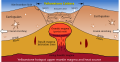 TNT equivalent
 -
 TNT equivalent
 -
 TNT equivalent
 -
 TNT equivalent


_cropped.png)
