Tumor antigen: Difference between revisions
CSV import |
CSV import |
||
| Line 36: | Line 36: | ||
[[Category:Immunology]] | [[Category:Immunology]] | ||
[[Category:Oncology]] | [[Category:Oncology]] | ||
== Tumor_antigen == | |||
<gallery> | |||
File:The_spectrum_of_target_antigens_associated_with_tumor_immunity_and_allo-immunity_after_allogeneic_HSCT..jpg|The spectrum of target antigens associated with tumor immunity and allo-immunity after allogeneic HSCT | |||
File:Processing_of_tumor_antigens_recognized_by_CD8+_T_cells.jpg|Processing of tumor antigens recognized by CD8+ T cells | |||
File:Classes_of_human_tumor_antigens_recognized_by_T_lymphocytes,_with_their_genetic_process.jpg|Classes of human tumor antigens recognized by T lymphocytes, with their genetic process | |||
</gallery> | |||
Latest revision as of 11:24, 18 February 2025
Antigens associated with tumor cells

A tumor antigen is a molecule expressed on the surface of tumor cells that can be recognized by the immune system, particularly by T cells. These antigens can be used as targets for cancer immunotherapy and are crucial in the development of cancer vaccines.
Types of Tumor Antigens[edit]
Tumor antigens are generally classified into two main categories: tumor-specific antigens (TSAs) and tumor-associated antigens (TAAs).
Tumor-Specific Antigens[edit]
Tumor-specific antigens are unique to cancer cells and are not found on normal cells. These antigens arise from mutations in tumor cells that lead to the production of novel proteins. TSAs are ideal targets for immunotherapy because they minimize the risk of attacking normal tissues.
Tumor-Associated Antigens[edit]
Tumor-associated antigens are present on both cancerous and normal cells but are overexpressed in tumor cells. These antigens include proteins such as carcinoembryonic antigen (CEA) and alpha-fetoprotein (AFP). TAAs are more common than TSAs and are often used in diagnostic tests and as targets for monoclonal antibody therapies.
Immune Recognition[edit]
The immune system recognizes tumor antigens through the presentation of peptides on major histocompatibility complex (MHC) molecules. CD8+ T cells recognize antigens presented by MHC class I molecules, while CD4+ T cells recognize those presented by MHC class II molecules.

Role in Cancer Immunotherapy[edit]
Tumor antigens are central to the development of cancer immunotherapies, including checkpoint inhibitors, CAR T-cell therapy, and cancer vaccines. These therapies aim to enhance the immune system's ability to recognize and destroy cancer cells by targeting specific tumor antigens.
Challenges and Future Directions[edit]
One of the main challenges in targeting tumor antigens is the potential for immune tolerance and the heterogeneity of antigen expression among different tumors. Research is ongoing to identify new tumor antigens and to develop strategies to overcome these challenges.
Related Pages[edit]
References[edit]
<references group="" responsive="1"></references>
Tumor_antigen[edit]
-
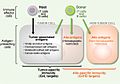 The spectrum of target antigens associated with tumor immunity and allo-immunity after allogeneic HSCT
 -
 Processing of tumor antigens recognized by CD8+ T cells
 -
 Classes of human tumor antigens recognized by T lymphocytes, with their genetic process

