Tarsometatarsal joints: Difference between revisions
CSV import Tags: mobile edit mobile web edit |
CSV import |
||
| Line 22: | Line 22: | ||
[[Category:Foot]] | [[Category:Foot]] | ||
{{stub}} | {{stub}} | ||
<gallery> | |||
File:Articulationes_tarsometatarsales-la.svg|Diagram of the tarsometatarsal joints | |||
File:Gray355.png|Bones of the foot, showing tarsometatarsal joints | |||
File:Gray358.png|Ligaments of the foot, including tarsometatarsal ligaments | |||
File:Slide2CEC1.JPG|Tarsometatarsal joints | |||
File:Slide3CEC2.JPG|Tarsometatarsal joints | |||
File:Slide6CEC5.JPG|Tarsometatarsal joints | |||
File:Slide7CEC6.JPG|Tarsometatarsal joints | |||
File:Slide1xzxz.JPG|Tarsometatarsal joints | |||
File:Slide2xzxzx.JPG|Tarsometatarsal joints | |||
File:Slide1cdcd.JPG|Tarsometatarsal joints | |||
</gallery> | |||
Latest revision as of 11:21, 18 February 2025
Tarsometatarsal joints (also known as Lisfranc joints) are the articulations in the foot between the tarsal bones and the metatarsal bones. They are named after Jacques Lisfranc de St. Martin, a French surgeon and gynecologist who first described the injury to these joints in 1815.
Etymology[edit]
The term "Lisfranc" is derived from the name of Jacques Lisfranc de St. Martin, a French surgeon and gynecologist. He was the first to describe the injury to these joints in 1815 during the Napoleonic Wars. He noted that cavalrymen who fell from their horses but kept their foot caught in the stirrup often sustained this type of injury.
Anatomy[edit]
The tarsometatarsal joints are complex and consist of three types of joints: the first is a synovial joint between the first metatarsal and the medial cuneiform, the second is a synovial joint between the second metatarsal and the middle cuneiform, and the third is a synovial joint between the third, fourth, and fifth metatarsals and the lateral cuneiform and the cuboid.
Function[edit]
The tarsometatarsal joints play a crucial role in the normal function of the foot. They allow for the necessary movements of the foot, including flexion, extension, abduction, adduction, and some rotation. These movements are essential for walking, running, and jumping.
Clinical significance[edit]
Injuries to the tarsometatarsal joints, known as Lisfranc injuries, can be severe and often require surgical intervention. They can occur due to direct trauma, such as a heavy object falling on the foot, or indirect trauma, such as the foot twisting during a fall. These injuries can lead to long-term complications, including chronic pain, arthritis, and difficulty walking.
See also[edit]
 | |
|---|---|
 |
 |
-
 Diagram of the tarsometatarsal joints
 -
 Bones of the foot, showing tarsometatarsal joints
 -
 Ligaments of the foot, including tarsometatarsal ligaments
 -
 Tarsometatarsal joints
 -
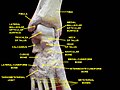 Tarsometatarsal joints
 -
 Tarsometatarsal joints
 -
 Tarsometatarsal joints
 -
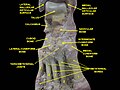 Tarsometatarsal joints
 -
 Tarsometatarsal joints
 -
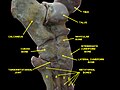 Tarsometatarsal joints


