Protocell: Difference between revisions
CSV import Tags: mobile edit mobile web edit |
CSV import |
||
| Line 29: | Line 29: | ||
[[Category:Evolutionary biology]] | [[Category:Evolutionary biology]] | ||
{{biology-stub}} | {{biology-stub}} | ||
<gallery> | |||
File:Phospholipids_aqueous_solution_structures.svg|Phospholipids in aqueous solution structures | |||
File:Micelle_scheme-en.svg|Micelle structure | |||
File:Pore_schematic.svg|Pore schematic | |||
File:Lipid_bilayer_section.gif|Lipid bilayer section | |||
File:Surfactant.jpg|Surfactant | |||
</gallery> | |||
Latest revision as of 05:03, 18 February 2025
Protocell is a theoretical self-replicating, self-organizing, non-living entity that exhibits some characteristics of life. Protocells are considered the precursors to life and are a key component in theories about the origin of life.
Definition[edit]
A protocell is defined as a self-organized, endogenously ordered, spherical collection of lipids proposed as a stepping-stone to the origin of life. Protocells are not living organisms as they do not possess a genetic system, but they provide a path for understanding how life might have originated from non-living matter.
Composition[edit]
Protocells are composed of simple organic molecules that are believed to have existed on the prebiotic earth. The primary components of protocells are lipids, which are capable of self-assembling into a bilayer, forming a membrane. This membrane encapsulates a variety of organic molecules, allowing for chemical reactions to occur within a contained environment.
Formation[edit]
The formation of protocells is believed to have occurred in the early stages of the Earth's existence, during the Hadean and Archean eons. The process involves the self-assembly of lipids into a bilayer, followed by the encapsulation of organic molecules. This process is driven by the hydrophobic effect, where non-polar molecules aggregate to minimize their exposure to water.
Significance[edit]
Protocells are significant in the study of the origin of life as they provide a plausible pathway from simple organic molecules to complex living organisms. They demonstrate how self-organization and self-replication could have occurred in the prebiotic world, leading to the emergence of life.
Research[edit]
Research into protocells is a multidisciplinary field, involving aspects of chemistry, biology, physics, and earth science. Current research focuses on understanding the properties of protocells, such as their stability, growth, division, and ability to encapsulate and process information.
See also[edit]
References[edit]
<references />

-
 Phospholipids in aqueous solution structures
 -
 Micelle structure
 -
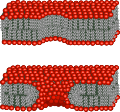 Pore schematic
 -
 Lipid bilayer section
 -
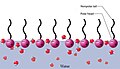 Surfactant


