T helper cell: Difference between revisions
CSV import Tags: mobile edit mobile web edit |
CSV import Tags: mobile edit mobile web edit |
||
| Line 27: | Line 27: | ||
{{Immunology-stub}} | {{Immunology-stub}} | ||
<gallery> | |||
File:Activation_of_T_and_B_cells.png|Activation of T and B cells | |||
File:T-dependent_B_cell_activation.png|T-dependent B cell activation | |||
File:Antigen_presentation.svg|Antigen presentation | |||
File:Lymphocyte_activation.png|Lymphocyte activation | |||
</gallery> | |||
Latest revision as of 05:01, 18 February 2025
T helper cells (also known as Th cells) are a type of T cell that play a crucial role in the immune system, particularly in the adaptive immune system. They help the activity of other immune cells by releasing T cell cytokines. These cells help suppress or regulate immune responses. They are essential in B cell antibody class switching, in the activation and growth of cytotoxic T cells, and in maximizing bactericidal activity of phagocytes such as macrophages.
Classification[edit]
Based on function, T helper cells can be classified into several subsets, including Th1, Th2, Th17, Tfh, and Treg cells. Each subset is distinguished by their cytokine production and function.
Function[edit]
T helper cells recognize antigens presented by antigen-presenting cells (APCs) in the context of major histocompatibility complex (MHC) class II molecules. Once activated, they divide rapidly and secrete small proteins known as cytokines that regulate or assist in the active immune response.
Activation[edit]
The activation of a T helper cell involves its interaction with an antigen-presenting cell. This interaction involves a simultaneous engagement of the T cell receptor and a co-receptor (CD4) on the T helper cell with the MHC class II molecule and the antigenic peptide, respectively, on the APC.
Role in disease[edit]
T helper cells play a central role in several immune-related diseases. For example, they are the primary target of HIV infection, and their depletion leads to the immunodeficiency characteristic of AIDS. In autoimmune diseases such as Multiple sclerosis, T helper cells appear to play a role in mediating pathological damage.
See also[edit]
This article is a immunology stub. You can help WikiMD by expanding it!
-
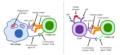 Activation of T and B cells
 -
T-dependent B cell activation
-
Antigen presentation
-
Lymphocyte activation


