Artificial white blood cells: Difference between revisions
CSV import |
CSV import |
||
| (One intermediate revision by the same user not shown) | |||
| Line 1: | Line 1: | ||
{{Short description|Overview of artificial white blood cells}} | |||
{{Use dmy dates|date=October 2023}} | |||
== | ==Artificial white blood cells== | ||
The | Artificial white blood cells are synthetic constructs designed to mimic the functions of natural [[white blood cells]] (WBCs) in the human body. These artificial cells are engineered to perform various immune functions, such as identifying and neutralizing pathogens, removing dead cells, and modulating immune responses. The development of artificial white blood cells is a significant advancement in [[biomedical engineering]] and [[nanotechnology]], with potential applications in treating [[autoimmune diseases]], [[cancer]], and [[infectious diseases]]. | ||
==Design and Function== | ===Design and Function=== | ||
Artificial | Artificial white blood cells are typically designed using a combination of [[biomaterials]], [[nanoparticles]], and [[biological molecules]]. These components are assembled to create a structure that can circulate in the bloodstream and interact with other cells and molecules in the immune system. The design often includes: | ||
* '''Recognition elements''': These are molecules that allow the artificial cells to identify specific targets, such as [[bacteria]], [[viruses]], or [[cancer cells]]. Common recognition elements include [[antibodies]] and [[aptamers]]. | |||
* '''Effector mechanisms''': Once a target is recognized, the artificial cell can deploy various mechanisms to neutralize or destroy it. This may involve releasing [[cytotoxic]] agents, generating [[reactive oxygen species]], or triggering [[apoptosis]] in target cells. | |||
* '''Communication capabilities''': Artificial white blood cells can be designed to communicate with natural immune cells, enhancing or modulating the immune response. This can be achieved through the release of [[cytokines]] or other signaling molecules. | |||
===Applications=== | |||
The potential applications of artificial white blood cells are vast and varied. Some of the key areas include: | |||
* '''Cancer therapy''': Artificial WBCs can be engineered to specifically target and destroy cancer cells, reducing the need for [[chemotherapy]] and its associated side effects. | |||
[[Category: | * '''Infectious disease treatment''': These synthetic cells can be used to combat [[antibiotic-resistant bacteria]] and [[viral infections]], providing a new line of defense against emerging pathogens. | ||
* '''Autoimmune disease management''': By modulating the immune response, artificial white blood cells can help manage conditions where the immune system attacks the body's own tissues, such as [[rheumatoid arthritis]] and [[lupus]]. | |||
===Challenges and Future Directions=== | |||
Despite their potential, the development of artificial white blood cells faces several challenges: | |||
* '''Biocompatibility''': Ensuring that artificial cells do not provoke an adverse immune response or cause toxicity in the body is crucial. | |||
* '''Target specificity''': Achieving high specificity in target recognition to avoid off-target effects and damage to healthy tissues. | |||
* '''Scalability and cost''': Developing cost-effective methods for large-scale production of artificial white blood cells. | |||
Future research is focused on overcoming these challenges and exploring new materials and technologies to enhance the functionality and safety of artificial white blood cells. | |||
==Related pages== | |||
* [[White blood cell]] | |||
* [[Nanotechnology in medicine]] | |||
* [[Immunotherapy]] | |||
* [[Biomaterials]] | |||
==Gallery== | |||
<gallery> | |||
File:Eicosanoid_synthesis.svg|Eicosanoid synthesis pathway | |||
</gallery> | |||
[[Category:Biomedical engineering]] | |||
[[Category:Immunology]] | [[Category:Immunology]] | ||
[[Category: | [[Category:Nanotechnology]] | ||
<gallery caption="Artificial_white_blood_cells"> | |||
File:Red_White_Blood_cells.png|Red and white blood cells | |||
File:Blausen_0909_WhiteBloodCells.png|Illustration of white blood cells | |||
File:Liposome_cross_section.png|Cross-section of a liposome | |||
File:Giant-Polymersome-Protocells-Dock-with-Virus-Particle-Mimics-via-Multivalent-Glycan-Lectin-srep32414-s3.ogv|Giant polymersome protocells docking with virus particle mimics | |||
File:CellMembraneDrawing_numbered.jpg|Diagram of a cell membrane | |||
</gallery> | |||
Latest revision as of 04:57, 18 February 2025
Overview of artificial white blood cells
Artificial white blood cells[edit]
Artificial white blood cells are synthetic constructs designed to mimic the functions of natural white blood cells (WBCs) in the human body. These artificial cells are engineered to perform various immune functions, such as identifying and neutralizing pathogens, removing dead cells, and modulating immune responses. The development of artificial white blood cells is a significant advancement in biomedical engineering and nanotechnology, with potential applications in treating autoimmune diseases, cancer, and infectious diseases.
Design and Function[edit]
Artificial white blood cells are typically designed using a combination of biomaterials, nanoparticles, and biological molecules. These components are assembled to create a structure that can circulate in the bloodstream and interact with other cells and molecules in the immune system. The design often includes:
- Recognition elements: These are molecules that allow the artificial cells to identify specific targets, such as bacteria, viruses, or cancer cells. Common recognition elements include antibodies and aptamers.
- Effector mechanisms: Once a target is recognized, the artificial cell can deploy various mechanisms to neutralize or destroy it. This may involve releasing cytotoxic agents, generating reactive oxygen species, or triggering apoptosis in target cells.
- Communication capabilities: Artificial white blood cells can be designed to communicate with natural immune cells, enhancing or modulating the immune response. This can be achieved through the release of cytokines or other signaling molecules.
Applications[edit]
The potential applications of artificial white blood cells are vast and varied. Some of the key areas include:
- Cancer therapy: Artificial WBCs can be engineered to specifically target and destroy cancer cells, reducing the need for chemotherapy and its associated side effects.
- Infectious disease treatment: These synthetic cells can be used to combat antibiotic-resistant bacteria and viral infections, providing a new line of defense against emerging pathogens.
- Autoimmune disease management: By modulating the immune response, artificial white blood cells can help manage conditions where the immune system attacks the body's own tissues, such as rheumatoid arthritis and lupus.
Challenges and Future Directions[edit]
Despite their potential, the development of artificial white blood cells faces several challenges:
- Biocompatibility: Ensuring that artificial cells do not provoke an adverse immune response or cause toxicity in the body is crucial.
- Target specificity: Achieving high specificity in target recognition to avoid off-target effects and damage to healthy tissues.
- Scalability and cost: Developing cost-effective methods for large-scale production of artificial white blood cells.
Future research is focused on overcoming these challenges and exploring new materials and technologies to enhance the functionality and safety of artificial white blood cells.
Related pages[edit]
Gallery[edit]
-
 Eicosanoid synthesis pathway

- Artificial_white_blood_cells
-
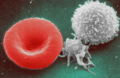 Red and white blood cells
 -
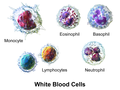 Illustration of white blood cells
 -
 Cross-section of a liposome
 -
 Giant polymersome protocells docking with virus particle mimics
 -
 Diagram of a cell membrane


