Porchetta: Difference between revisions
No edit summary |
CSV import |
||
| Line 29: | Line 29: | ||
{{Pork}} | {{Pork}} | ||
{{food-stub}} | {{food-stub}} | ||
<gallery> | |||
File:Porchetta_(3168207946).jpg|Porchetta | |||
File:Porchetta_Luco_dei_Marsi.jpg|Porchetta in Luco dei Marsi | |||
File:Porchetta_sagra_del_vino_Marino_2006.jpg|Porchetta at Sagra del Vino Marino 2006 | |||
File:Porchetta_Sandwich.jpg|Porchetta Sandwich | |||
</gallery> | |||
Latest revision as of 04:55, 18 February 2025

| Italian cuisine |
|---|
|
|
Porchetta is a savory, fatty, and moist boneless pork roast of Italian culinary tradition. The body of the pig is gutted, deboned, arranged carefully with layers of stuffing, meat, fat, and skin, then rolled, spitted, and roasted, traditionally over wood. Porchetta is usually heavily salted in addition to being stuffed with garlic, rosemary, fennel, or other herbs, often wild.
History[edit]
Porchetta has been selected by the Italian Ministry of Agricultural, Food and Forestry Policy as a prodotto agroalimentare tradizionale (“traditional agricultural-food product”, one of a list of traditional Italian foods held to have cultural relevance).
Preparation and Serving[edit]
In Italy, porchetta is often consumed as a sandwich filler, or served on its own, or sometimes it is chopped up and added to other dishes. It is a common street food in Rome and Lazio served from a porchetta stand, and it is also a staple of Sardinian cuisine.
Regional Variations[edit]
There are many regional variations of porchetta throughout Italy, all of which boast their own traditional preparation methods and seasonings. In Abruzzo, porchetta abruzzese is generally slow roasted with rosemary, garlic and pepper. In Umbria, porchetta is spit-roasted and flavored with garlic and wild fennel.
See Also[edit]
References[edit]
<references />
| Pork and Pork-related topics | ||||||||||
|---|---|---|---|---|---|---|---|---|---|---|
This Pork related articles is a stub.
|

-
 Porchetta
 -
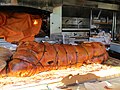 Porchetta in Luco dei Marsi
 -
 Porchetta at Sagra del Vino Marino 2006
 -
 Porchetta Sandwich
.jpg)


