Torque: Difference between revisions
CSV import |
CSV import |
||
| Line 59: | Line 59: | ||
[[Category:Mechanics]] | [[Category:Mechanics]] | ||
[[Category:Physics]] | [[Category:Physics]] | ||
<gallery> | |||
File:Torque_animation.gif|Torque animation | |||
File:Torque,_position,_and_force.svg|Torque, position, and force | |||
File:moment_arm.svg|Moment arm | |||
File:PrecessionOfATop.svg|Precession of a top | |||
File:Torque_Curve.svg|Torque curve | |||
</gallery> | |||
Latest revision as of 04:47, 18 February 2025
Torque[edit]
Torque, also known as moment of force, is the rotational equivalent of linear force. It represents the tendency of a force to rotate an object about an axis, fulcrum, or pivot. Just as a force is a push or a pull, a torque can be thought of as a twist to an object.
Definition[edit]
Torque is defined mathematically as the cross product of the position vector (distance from the axis of rotation) and the force vector. The formula for torque \( \tau \) is given by:
\[ \tau = \mathbf{r} \times \mathbf{F} \]
where \( \mathbf{r} \) is the position vector and \( \mathbf{F} \) is the force vector. The magnitude of the torque is given by:
\[ \tau = rF \sin \theta \]
where \( r \) is the distance from the axis of rotation to the point where the force is applied, \( F \) is the magnitude of the force, and \( \theta \) is the angle between the position vector and the force vector.
Units[edit]
The SI unit for torque is the newton metre (Nm). In the imperial system, torque is often measured in pound-feet (lb-ft).
Moment Arm[edit]
The moment arm is the perpendicular distance from the axis of rotation to the line of action of the force. It is a crucial component in calculating torque, as it determines the effectiveness of the force in producing rotational motion.

Applications[edit]
Torque is a fundamental concept in mechanics and is applied in various fields such as engineering, physics, and automotive industries. It is essential in the design and analysis of machines, engines, and structures.
Precession[edit]
Torque is also responsible for the phenomenon of precession, which is the change in the orientation of the rotational axis of a rotating body. This is commonly observed in gyroscopes and spinning tops.
Torque in Vehicles[edit]
In the context of automobiles, torque is a measure of an engine's ability to do work. It is a critical factor in determining a vehicle's performance, particularly in terms of acceleration and towing capacity.
Related Pages[edit]
References[edit]
- Halliday, D., Resnick, R., & Walker, J. (2013). Fundamentals of Physics. Wiley.
- Tipler, P. A., & Mosca, G. (2008). Physics for Scientists and Engineers. W. H. Freeman.
-
Torque animation
-
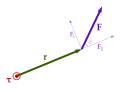 Torque, position, and force
 -
Moment arm
-
Precession of a top
-
Torque curve


