British Doctors Study: Difference between revisions
CSV import Tags: mobile edit mobile web edit |
CSV import |
||
| Line 32: | Line 32: | ||
{{medicine-stub}} | {{medicine-stub}} | ||
<gallery> | |||
File:British_doctors_study_35.svg|British Doctors Study 35-Year Follow-Up | |||
File:British_doctors_study_40.svg|British Doctors Study 40-Year Follow-Up | |||
File:British_doctors_study_50.svg|British Doctors Study 50-Year Follow-Up | |||
File:British_doctors_study_60.svg|British Doctors Study 60-Year Follow-Up | |||
</gallery> | |||
Latest revision as of 04:46, 18 February 2025
British Doctors Study
The British Doctors Study was a long-term epidemiological study conducted by Richard Doll and Austin Bradford Hill, who were British medical researchers. The study began in 1951 and aimed to establish the link between tobacco smoking and lung cancer. This study was instrumental in the development of our understanding of the harmful effects of smoking and has had a significant impact on public health policies worldwide.
Background[edit]
In the early 20th century, the incidence of lung cancer began to rise dramatically. This increase coincided with the rise in popularity of cigarette smoking, but the connection was not immediately clear. Richard Doll and Austin Bradford Hill, two British medical researchers, decided to investigate this possible link.
Methodology[edit]
The British Doctors Study was a cohort study that involved approximately 40,000 British doctors. The doctors were asked about their smoking habits and were then followed up over several years. The health outcomes of the doctors were then compared based on their smoking habits.
Findings[edit]
The study found a strong correlation between cigarette smoking and lung cancer. The risk of lung cancer was found to be significantly higher in smokers compared to non-smokers. The study also found a dose-response relationship, with heavier smokers having a higher risk of lung cancer.
Impact[edit]
The findings of the British Doctors Study had a profound impact on public health. They provided strong evidence of the harmful effects of smoking and led to significant changes in public health policy. The study also contributed to a shift in societal attitudes towards smoking.
See also[edit]

-
 British Doctors Study 35-Year Follow-Up
 -
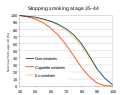 British Doctors Study 40-Year Follow-Up
 -
 British Doctors Study 50-Year Follow-Up
 -
 British Doctors Study 60-Year Follow-Up


