Citric acid: Difference between revisions
No edit summary |
CSV import Tags: mobile edit mobile web edit |
||
| Line 61: | Line 61: | ||
[[Category:Biodegradable substances]] | [[Category:Biodegradable substances]] | ||
[[Category:Eco-friendly products]] | [[Category:Eco-friendly products]] | ||
== Citric_acid == | |||
<gallery> | |||
File:Kyselina_citronová.png|Citric acid crystal structure | |||
File:Citrus_fruits.jpg|Various citrus fruits | |||
File:Citric_acid_speciation.svg|Speciation of citric acid | |||
File:Lemon_pepper_preparation.jpg|Preparation of lemon pepper | |||
File:Fe2CITdianion.svg|Iron(II) citrate dianion | |||
</gallery> | |||
Latest revision as of 04:39, 18 February 2025
Citric Acid[edit]
Citric acid is a weak organic acid that occurs naturally in citrus fruits, such as lemons, limes, and oranges. It is commonly used as a flavoring agent, preservative, and cleaning agent in various industries, including food and beverage, pharmaceuticals, and cosmetics.
Chemical Properties[edit]
Citric acid (C6H8O7) is a tricarboxylic acid with three carboxyl groups, giving it a strong acidic character. It is a white crystalline powder that is soluble in water and has a sour taste.
Sources and Production[edit]
Citric acid is found naturally in various fruits and vegetables, with the highest concentrations found in citrus fruits. Industrially, citric acid is produced through fermentation, typically using the fungus Aspergillus niger to convert sugar into citric acid.
Uses[edit]
Citric acid has numerous applications across various industries:
- Food and Beverage: Citric acid is used as a flavoring agent to add a sour taste to food and beverages, as well as a preservative to prevent spoilage.
- Pharmaceuticals: Citric acid is used in the production of effervescent tablets and as a pH adjuster in medications.
- Cosmetics: Citric acid is used as a pH adjuster in cosmetic products, such as creams, lotions, and shampoos.
- Cleaning: Citric acid is an effective cleaning agent due to its ability to dissolve mineral deposits and act as a mild abrasive.
References[edit]
<references> 1. PubChem. (n.d.). Citric Acid. Retrieved from https://pubchem.ncbi.nlm.nih.gov/compound/Citric-acid 2. Shah, V. (2018). Citric Acid: Properties, Production, and Applications. In Bioprocessing for Value-Added Products from Renewable Resources (pp. 549-564). Elsevier. </references>
See Also[edit]
| This article is a stub. You can help WikiMD by registering to expand it. |
Environmental Impact[edit]
Citric acid, being a naturally occurring compound, is considered to be a more environmentally friendly option compared to other synthetic chemicals used in various applications. However, the production of citric acid through industrial fermentation processes may have some environmental impacts, such as greenhouse gas emissions and wastewater generation. Efforts have been made to optimize the production process and reduce its environmental footprint.
Biodegradability[edit]
Citric acid is biodegradable, meaning that it can be broken down by microorganisms in the environment. This makes it a preferable option for use in eco-friendly cleaning products and other applications where the release of chemicals into the environment is a concern.
Health Considerations[edit]
Citric acid is generally considered safe for consumption and use in food, pharmaceutical, and cosmetic products. However, some individuals may be sensitive or allergic to citric acid, experiencing symptoms such as skin irritation, itching, or gastrointestinal discomfort upon exposure.
In cleaning products, citric acid may cause eye or skin irritation if not used according to the product's instructions. It is essential to follow the guidelines provided by the manufacturer to ensure safe and effective use.
References[edit]
<references>
- Werpy, T., & Petersen, G. (2004). Top Value Added Chemicals from Biomass. Volume I—Results of Screening for Potential Candidates from Sugars and Synthesis Gas. (DOE/GO-102004-1992). U.S. Department of Energy. Retrieved from https://www.nrel.gov/docs/fy04osti/35523.pdf
- Cosmetic Ingredient Review Expert Panel. (2014). Safety Assessment of Citric Acid, Inorganic Citrate Salts, and Alkyl Citrate Esters as Used in Cosmetics. International Journal of Toxicology, 33(3_suppl), 16S-46S.
</references>
See Also[edit]
| This article is a stub. You can help WikiMD by registering to expand it. |
Citric_acid[edit]
-
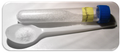 Citric acid crystal structure
 -
Various citrus fruits
-
Speciation of citric acid
-
Preparation of lemon pepper
-
Iron(II) citrate dianion


