Davis Submerged Escape Apparatus: Difference between revisions
CSV import Tags: mobile edit mobile web edit |
CSV import |
||
| Line 23: | Line 23: | ||
[[Category:Submarine escape equipment]] | [[Category:Submarine escape equipment]] | ||
{{Submarine-stub}} | {{Submarine-stub}} | ||
<gallery> | |||
File:Davis_Submerged_Escape_Apparatus.jpg|Davis Submerged Escape Apparatus | |||
File:New_Davis_Breathing_Apparatus_Tested_at_the_Submarine_Escape_Test_Tank_at_HMS_Dolphin_Gosport,_14_December_1942_A13873.jpg|New Davis Breathing Apparatus Tested at the Submarine Escape Test Tank at HMS Dolphin Gosport, 14 December 1942 | |||
File:Lionel_Crabb.jpg|Davis Submerged Escape Apparatus | |||
</gallery> | |||
Latest revision as of 04:18, 18 February 2025
Davis Submerged Escape Apparatus (DSEA) is a type of underwater breathing apparatus that was designed for escape from sunken submarines. The apparatus was invented by Sir Robert H. Davis, head of Siebe Gorman, a British company that developed diving and submarine escape equipment.
History[edit]
The Davis Submerged Escape Apparatus was first introduced in 1927. It was adopted by the Royal Navy and was used extensively during the World War II period. The DSEA was the standard issue escape gear in British submarines from the 1930s until it was replaced by the Steinke hood in the 1960s.
Design and Function[edit]
The DSEA consists of a rebreather bag containing oxygen and a mouthpiece with a nose clip. The bag is filled with pure oxygen from a small cylinder. The user exhales into the bag, where the exhaled air is scrubbed of carbon dioxide by a chemical reaction and then re-inhaled. The apparatus is designed to be used at depths of up to 30 metres.
The DSEA is designed to be simple to use, even in the stressful and potentially disorienting situation of a submarine escape. The user simply has to put the mouthpiece in their mouth, clip their nose shut, and breathe normally. The apparatus provides a constant supply of oxygen, allowing the user to ascend to the surface at a controlled rate to avoid decompression sickness.
Legacy[edit]
The Davis Submerged Escape Apparatus played a significant role in the history of submarine escape technology. It was the first apparatus of its kind to be adopted by a major navy, and its design principles have influenced subsequent developments in the field. Today, the DSEA is remembered as a pioneering piece of equipment that contributed to the safety and survival of submarine crews.
See also[edit]

-
 Davis Submerged Escape Apparatus
 -
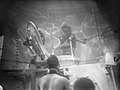 New Davis Breathing Apparatus Tested at the Submarine Escape Test Tank at HMS Dolphin Gosport, 14 December 1942
 -
 Davis Submerged Escape Apparatus


