Cissampelos pareira: Difference between revisions
CSV import Tags: mobile edit mobile web edit |
CSV import |
||
| Line 24: | Line 24: | ||
{{flora-stub}} | {{flora-stub}} | ||
{{medicine-stub}} | {{medicine-stub}} | ||
<gallery> | |||
File:Cissampelos_pareira_NP.JPG|Cissampelos pareira plant | |||
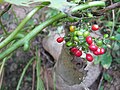
File:Cissampelos_pareira_fruits.JPG|Cissampelos pareira fruits | |||
File:Velvet_Leaf_(7426398408).jpg|Cissampelos pareira | |||
</gallery> | |||
Latest revision as of 04:01, 18 February 2025
Cissampelos pareira is a species of flowering plant in the family Menispermaceae, native to tropical and subtropical regions of the world. It is commonly known as velvetleaf, abuta, or barbasco among other names. The plant is used in traditional medicine in many cultures, and it has been investigated for potential medicinal properties.
Description[edit]
Cissampelos pareira is a climbing plant with a woody stem. The leaves are heart-shaped and the flowers are small and greenish-yellow. The plant produces clusters of small, round, black berries.
Distribution and habitat[edit]
Cissampelos pareira is native to tropical and subtropical regions of the world, including the Americas, Africa, and Asia. It is typically found in forests and other wooded areas.
Uses[edit]
Cissampelos pareira has a long history of use in traditional medicine. It is used in Ayurvedic medicine to treat a variety of conditions, including digestive problems, respiratory ailments, and skin diseases. In South America, the plant is used to treat wounds, inflammation, and menstrual problems.
Research[edit]
Research into the potential medicinal properties of Cissampelos pareira has focused on its anti-inflammatory, antimicrobial, and antiviral effects. Some studies have suggested that the plant may have potential as a treatment for malaria and dengue fever.
See also[edit]

This flora-related article is a stub. You can help WikiMD by expanding it.

-
 Cissampelos pareira plant
 -
 Cissampelos pareira fruits
 -
 Cissampelos pareira


.jpg)
