Toxocara canis: Difference between revisions
CSV import |
CSV import |
||
| (One intermediate revision by the same user not shown) | |||
| Line 1: | Line 1: | ||
== Toxocara canis == | |||
[[File:Canine_roundworm_1.JPG|thumb|right|Toxocara canis adult worms]] | |||
'''Toxocara canis''' is a parasitic [[roundworm]] of dogs and other canids. It is one of the most common [[helminth]] infections in dogs and can also infect humans, causing [[toxocariasis]]. | |||
== | == Description == | ||
Toxocara canis is a large, white worm that can grow up to 15 cm in length. The adult worms reside in the small intestine of the host, where they feed on the host's intestinal contents. The female worms are prolific egg layers, producing thousands of eggs daily, which are passed in the host's feces. | |||
== Life Cycle == | |||
[[File:Toxocara_canis_LifeCycle.gif|thumb|right|Life cycle of Toxocara canis]] | |||
The life cycle of Toxocara canis involves several stages: | |||
# Adult worms in the intestine of the definitive host (usually a dog) lay eggs that are excreted in the feces. | |||
# The eggs become embryonated in the environment, becoming infective after 2-4 weeks. | |||
# When a dog ingests the infective eggs, the larvae hatch in the intestine and migrate through the tissues. | |||
# In young dogs, the larvae migrate through the liver and lungs, eventually returning to the intestine to mature into adult worms. | |||
# In older dogs, the larvae may become dormant in tissues, reactivating during pregnancy to infect puppies via the placenta or milk. | |||
== | == Transmission and Infection == | ||
Toxocara canis is primarily transmitted through the ingestion of infective eggs from contaminated soil or feces. Puppies can also be infected transplacentally or through their mother's milk. Humans can become accidental hosts by ingesting eggs, leading to [[visceral larva migrans]] or [[ocular larva migrans]]. | |||
== Symptoms == | |||
In dogs, symptoms of Toxocara canis infection can include diarrhea, vomiting, a pot-bellied appearance, and poor growth. In humans, the symptoms depend on the organs affected by migrating larvae and can include fever, fatigue, and abdominal pain. | |||
== | == Diagnosis and Treatment == | ||
Diagnosis in dogs is typically made by identifying eggs in fecal samples. Treatment involves the use of anthelmintic medications such as [[pyrantel pamoate]] or [[fenbendazole]]. Preventative measures include regular deworming and proper disposal of dog feces. | |||
[[ | == Prevention == | ||
[[Category: | Preventing Toxocara canis infection involves regular deworming of dogs, especially puppies, and maintaining good hygiene practices to reduce environmental contamination. Public education on the risks of zoonotic transmission is also important. | ||
== Related Pages == | |||
* [[Toxocariasis]] | |||
* [[Roundworm]] | |||
* [[Helminthiasis]] | |||
== References == | |||
{{Reflist}} | |||
[[File:Dog_defecation_1.jpg|thumb|right|Proper disposal of dog feces is important to prevent the spread of Toxocara canis.]] | |||
[[Category:Parasitic nematodes of animals]] | |||
[[Category:Dog diseases]] | [[Category:Dog diseases]] | ||
<gallery> | |||
File:Canine_roundworm_1.JPG|Toxocara canis adult worm | |||
File:Dog_defecation_1.jpg|Dog defecating, potential source of Toxocara canis eggs | |||
File:Toxocara_canis_LifeCycle.gif|Life cycle of Toxocara canis | |||
</gallery> | |||
Latest revision as of 02:11, 18 February 2025
Toxocara canis[edit]

Toxocara canis is a parasitic roundworm of dogs and other canids. It is one of the most common helminth infections in dogs and can also infect humans, causing toxocariasis.
Description[edit]
Toxocara canis is a large, white worm that can grow up to 15 cm in length. The adult worms reside in the small intestine of the host, where they feed on the host's intestinal contents. The female worms are prolific egg layers, producing thousands of eggs daily, which are passed in the host's feces.
Life Cycle[edit]

The life cycle of Toxocara canis involves several stages:
- Adult worms in the intestine of the definitive host (usually a dog) lay eggs that are excreted in the feces.
- The eggs become embryonated in the environment, becoming infective after 2-4 weeks.
- When a dog ingests the infective eggs, the larvae hatch in the intestine and migrate through the tissues.
- In young dogs, the larvae migrate through the liver and lungs, eventually returning to the intestine to mature into adult worms.
- In older dogs, the larvae may become dormant in tissues, reactivating during pregnancy to infect puppies via the placenta or milk.
Transmission and Infection[edit]
Toxocara canis is primarily transmitted through the ingestion of infective eggs from contaminated soil or feces. Puppies can also be infected transplacentally or through their mother's milk. Humans can become accidental hosts by ingesting eggs, leading to visceral larva migrans or ocular larva migrans.
Symptoms[edit]
In dogs, symptoms of Toxocara canis infection can include diarrhea, vomiting, a pot-bellied appearance, and poor growth. In humans, the symptoms depend on the organs affected by migrating larvae and can include fever, fatigue, and abdominal pain.
Diagnosis and Treatment[edit]
Diagnosis in dogs is typically made by identifying eggs in fecal samples. Treatment involves the use of anthelmintic medications such as pyrantel pamoate or fenbendazole. Preventative measures include regular deworming and proper disposal of dog feces.
Prevention[edit]
Preventing Toxocara canis infection involves regular deworming of dogs, especially puppies, and maintaining good hygiene practices to reduce environmental contamination. Public education on the risks of zoonotic transmission is also important.
Related Pages[edit]
References[edit]
<references group="" responsive="1"></references>

-
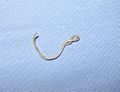 Toxocara canis adult worm
 -
 Dog defecating, potential source of Toxocara canis eggs
 -
 Life cycle of Toxocara canis
