Chuño: Difference between revisions
CSV import |
CSV import |
||
| Line 27: | Line 27: | ||
{{food-stub}} | {{food-stub}} | ||
{{medicine-stub}} | {{medicine-stub}} | ||
== Chuño == | |||
<gallery> | |||
File:Chuño.jpg|Chuño | |||
File:Alstroemeria_ligtu_Edwards's_25.13.1839.jpg|Alstroemeria ligtu illustration | |||
File:Maiz_con_chuño_y_aji_de_carne.jpg|Maiz con chuño y aji de carne | |||
</gallery> | |||
Latest revision as of 01:40, 18 February 2025
Chuño is a traditional Andean method of food preservation that involves the dehydration and freezing of potatoes. The process has been used for thousands of years by the indigenous peoples of the Andes region, including the Inca civilization. Chuño is a staple food in many Andean countries, including Peru, Bolivia, and Chile.
History[edit]
The practice of making chuño dates back to pre-Incan times. The Incas used chuño as a form of food storage during times of famine or for military campaigns. The process of making chuño allowed the Incas to have a reliable food source that could be stored for long periods.
Preparation[edit]
The process of making chuño involves several steps. First, potatoes are harvested and left in the open air to freeze during the cold Andean nights. During the day, the potatoes are exposed to the sun to thaw. This freeze-thaw cycle is repeated over several days until the potatoes are completely dehydrated.
Once the potatoes are dehydrated, they are trampled underfoot to remove the skins and any remaining moisture. The potatoes are then rinsed in a stream to remove any remaining dirt or impurities. The final product is a small, hard, and dry potato that can be stored for years without spoiling.
Culinary Uses[edit]
Chuño is a versatile ingredient that can be used in a variety of dishes. It can be rehydrated and used in soups, stews, and other dishes. In Bolivia, it is often used in a traditional dish called llajwa, a spicy sauce made with tomatoes, onions, and peppers.
Nutritional Value[edit]
Chuño is a good source of carbohydrates and provides some protein and fiber. It is low in fat and contains no cholesterol. However, the process of making chuño removes some of the vitamins and minerals found in fresh potatoes.
See Also[edit]


Chuño[edit]
-
 Chuño
Chuño -
 Alstroemeria ligtu illustration
 -
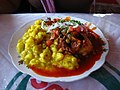 Maiz con chuño y aji de carne


