Limbus vertebra: Difference between revisions
CSV import Tags: mobile edit mobile web edit |
CSV import |
||
| Line 31: | Line 31: | ||
{{anatomy-stub}} | {{anatomy-stub}} | ||
<gallery> | |||
File:T2_W_Sagittal_image.jpg|T2-weighted sagittal MRI image | |||
File:T1_W_Sagittal.jpg|T1-weighted sagittal MRI image | |||
File:Limbus_Vertebra_L5.jpg|Limbus vertebra at L5 | |||
</gallery> | |||
Latest revision as of 01:16, 18 February 2025
Limbus vertebra is a medical condition that involves the vertebrae in the spinal column. It is characterized by the presence of a secondary ossification center, which is separated from the main body of the vertebra. This condition is often asymptomatic, but can sometimes cause back pain or other symptoms.
Anatomy[edit]
The vertebral column, also known as the spine, is made up of a series of small bones called vertebrae. These vertebrae are stacked on top of each other and form the main support structure for the body, allowing us to stand upright, bend, and twist. Each vertebra is separated by a intervertebral disc, which acts as a cushion and prevents the bones from rubbing against each other.
In a limbus vertebra, a portion of the bone, usually at the front of the vertebra, fails to fuse with the main body of the bone during development. This results in a separate piece of bone, or ossification center, which can be seen on an X-ray or MRI.
Symptoms[edit]
Many people with a limbus vertebra do not experience any symptoms. However, in some cases, the condition can cause back pain, especially when bending or twisting the spine. The pain is usually localized to the area of the affected vertebra.
Diagnosis[edit]
A limbus vertebra is usually diagnosed through imaging tests, such as an X-ray or MRI. These tests can show the separate ossification center and help to rule out other potential causes of back pain.
Treatment[edit]
Treatment for a limbus vertebra is usually conservative, focusing on managing symptoms rather than correcting the underlying condition. This can include physical therapy, pain medication, and in some cases, surgery.
See also[edit]

-
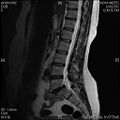 T2-weighted sagittal MRI image
 -
 T1-weighted sagittal MRI image
 -
 Limbus vertebra at L5


